Health Insurance
What’s Your Biggest Financial Fear?
This blog examines the most common financial fears faced by individuals and families in 2026, from income loss to rising medical costs and inflation. It explains how life insurance and health insurance address these risks in a structured and practical way. The article highlights the dangers of relying on a single financial product and the importance of balanced planning. It underscores how informed insurance decisions build long term financial confidence and security.
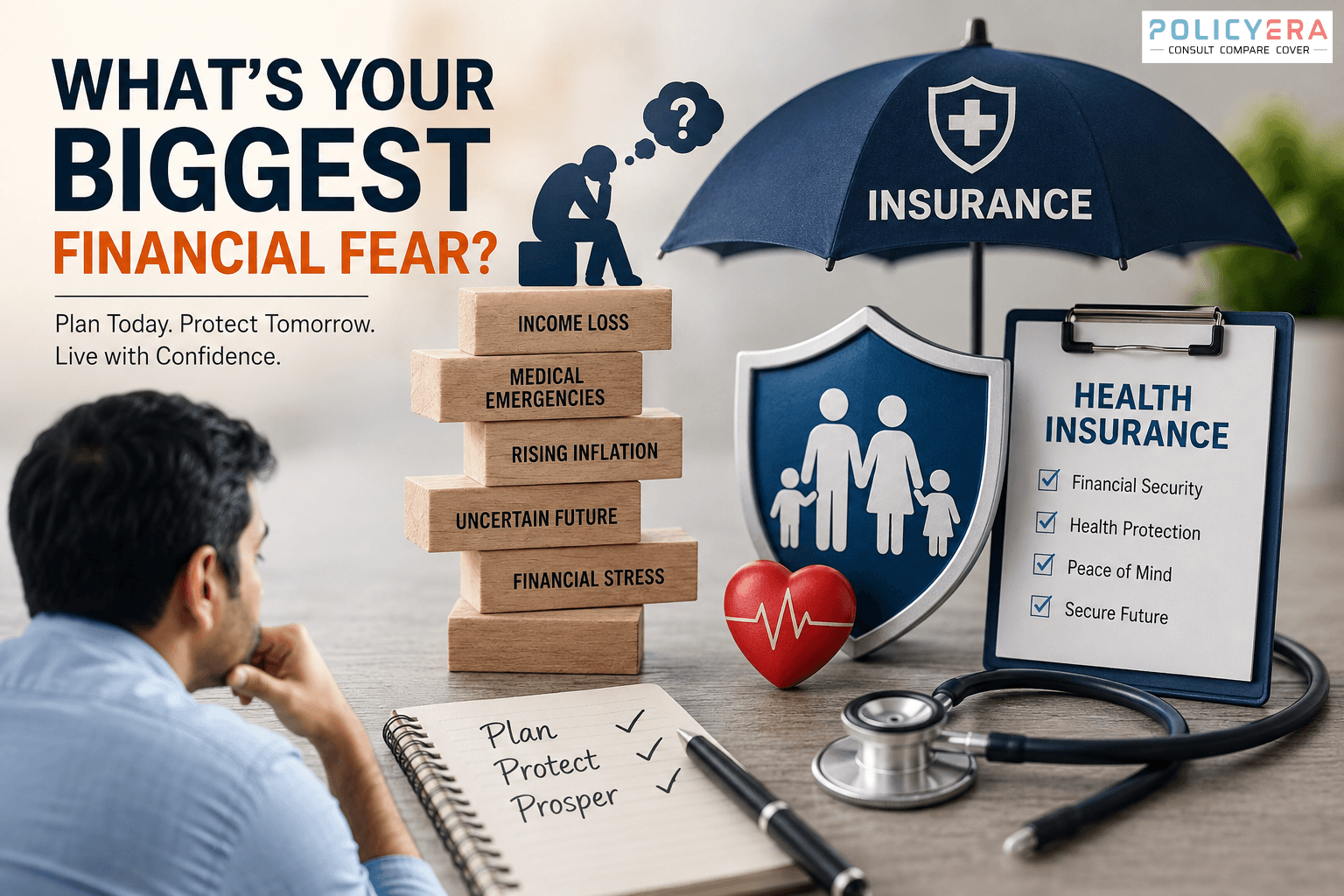
A financial planning visual showing income loss, medical emergencies, inflation, and financial stress, with health insurance and family protection represented as safeguards for financial security.
Financial fears are rarely abstract. They are deeply personal, shaped by responsibilities, aspirations, and uncertainty about the future. In 2026, rising healthcare costs, income volatility, inflationary pressure, and longer life expectancy have intensified these concerns for individuals and families across India. Insurance and financial planning are no longer optional safeguards. They are essential tools for stability and confidence. Understanding your biggest financial fear is the first step towards building a resilient protection strategy. The right mix of life insurance, health insurance, and long term planning can turn uncertainty into preparedness.
FEAR OF INCOME LOSS AND HOW LIFE INSURANCE PROTECTS YOUR FAMILY
For most households, income is the foundation of financial security. The sudden loss of a primary earning member can disrupt education plans, housing stability, and day to day living expenses. This fear remains one of the strongest motivators for life insurance adoption.
Life insurance acts as income replacement, ensuring that dependents can maintain their standard of living even in the absence of the insured individual. Adequate term insurance coverage helps families manage ongoing expenses, repay liabilities, and preserve long term goals such as higher education or retirement planning.
The key is not merely owning a policy, but ensuring that the sum assured reflects current income, future responsibilities, and inflation. Periodic review of life cover is critical as income levels and family needs evolve.
FEAR OF MEDICAL EMERGENCIES DRAINING SAVINGS
Healthcare costs in India continue to rise faster than general inflation. A single hospitalisation can significantly erode years of savings, especially when treatment involves private healthcare facilities. For many families, this fear has become more real in recent years.
Health insurance provides financial protection against medical emergencies by covering hospitalisation expenses, treatment costs, and associated care. Comprehensive policies help reduce out of pocket expenditure and allow families to focus on recovery rather than financial stress.
However, insufficient coverage, unawareness of policy terms, or dependence on limited employer provided insurance can leave gaps. Individual health policies with adequate sum insured, along with top up or super top up plans where necessary, offer more reliable protection across life stages.
FEAR OF INFLATION AND FALLING SHORT OF FUTURE GOALS
Inflation silently reduces purchasing power over time. Without proper planning, long term goals such as children’s education, home ownership, or retirement can become significantly more expensive than anticipated.
While insurance is not a substitute for investments, certain insurance products play a supportive role in financial planning by offering disciplined savings, risk protection, and stability. Life insurance ensures that financial goals are not derailed by unforeseen events, while health insurance prevents medical costs from consuming investment capital.
Addressing inflation related fears requires an integrated approach where insurance protects the downside risk and investments focus on growth. Ignoring either aspect can weaken overall financial resilience.
THE RISK OF RELYING ON A SINGLE FINANCIAL PRODUCT
One of the most common mistakes in financial planning is relying on a single product to address multiple risks. A savings plan without adequate life cover leaves dependents exposed. A life insurance policy without health coverage fails to protect against medical emergencies. Employer provided insurance alone may not offer continuity or sufficient limits.
Each financial risk requires a specific solution. Life insurance protects income and dependents. Health insurance safeguards savings. Investment planning addresses long term growth and inflation.
When one component is missing, financial stress shifts to other areas. A balanced portfolio of protection and planning tools reduces dependency on any single product and improves overall security.
BUILDING CONFIDENCE THROUGH COMBINED PLANNING
Financial confidence does not come from eliminating all risks, but from being prepared to manage them. Combining life insurance, health insurance, and structured financial planning creates a comprehensive safety net.
This integrated approach ensures that
• Families are protected against loss of income
• Medical emergencies do not derail savings or investments
• Long term goals remain achievable despite uncertainties
• Financial decisions are aligned with life stages and responsibilities
Such planning also allows individuals to make informed choices, take career or business risks with confidence, and focus on growth rather than fear.
THE ROLE OF THE RIGHT INSURANCE ADVISOR
Navigating insurance options can be complex. Product features, exclusions, claim conditions, and regulatory guidelines require careful understanding. Choosing the right advisor plays a crucial role in closing protection gaps and avoiding misalignment.
Advisory led platforms like Policy Era focus on need based planning rather than product driven selling. By assessing income, liabilities, family structure, and risk exposure, Policy Era helps individuals and businesses identify appropriate coverage across life and health insurance solutions.
Equally important is support during claims. Transparent guidance, documentation assistance, and policy education ensure that insurance delivers value when it is needed most.
MOVING FROM FEAR TO PREPAREDNESS
Financial fears are natural, but they should not dictate decisions. Informed planning transforms fear into preparedness. Insurance, when chosen correctly and reviewed periodically, becomes a tool for empowerment rather than anxiety.
By addressing income protection, healthcare costs, inflation, and risk concentration together, individuals can build a resilient financial foundation. The objective is not to predict every risk, but to be ready for uncertainty.
CONCLUSION
Your biggest financial fear reveals where protection is most needed. Whether it is income loss, medical expenses, or falling short of future goals, the solution lies in balanced and informed planning. Combining life insurance, health insurance, and long term financial strategies builds confidence in an unpredictable world.
With advisory support, transparent processes, and customised solutions, platforms like Policy Era help individuals and families move beyond fear towards financial clarity and security. In 2026, preparedness is not just wise planning. It is essential protection for everything that matters.
FAQs
1. Will a Health Emergency Destroy My Financial Independence Plans?
A health emergency can significantly affect your financial independence by draining savings and disrupting long-term financial goals. Adequate health insurance helps cover eligible medical expenses and protects your savings from unexpected hospitalisation costs.
2. How Much Should I Actually Spend on Health Insurance?
There is no fixed amount that suits everyone. Your health insurance budget should depend on your age, income, family size, medical needs, location, and desired coverage. The goal is to choose adequate coverage without compromising essential financial goals.
3. What Happens to My Health Insurance If I Lose My Job?
If your health insurance is provided by your employer, coverage may end when your employment ends, depending on the policy terms. Having an individual health insurance policy can provide greater continuity and reduce dependence on employer-provided coverage.
4. What If I Get Sick and Lose My Job? Health Insurance Protection Guide
Illness combined with job loss can create both medical and financial pressure. An individual health insurance policy can help manage eligible healthcare expenses even when employer-sponsored coverage is no longer available.
5. Can I Really Afford to Leave My Job? Hidden Health Insurance Costs Explained
Leaving a job can mean losing employer-sponsored health insurance and taking on the cost of individual coverage. Before becoming self-employed or changing jobs, consider premiums, coverage limits, deductibles, waiting periods, and existing medical needs.
6. How Much Should I Actually Budget for Health Insurance Monthly?
Your monthly health insurance budget should be based on the coverage you need rather than choosing the cheapest premium. Consider your age, family members, medical history, location, sum insured, and potential healthcare costs when planning your budget.