Health Insurance
Why Insurance Matters in 2026 Trends, Insights, and What It Means for You
This blog explains why insurance has become a core pillar of financial security in 2026 amid rising health, economic, and lifestyle risks. It explores key insurance trends and sector growth while highlighting the importance of informed planning for families and businesses. The piece aligns insurance decisions with long-term life goals rather than short-term cost considerations. It also reflects how advisory-driven platforms like Policy Era help individuals make transparent, compliant, and well-informed insurance choices.
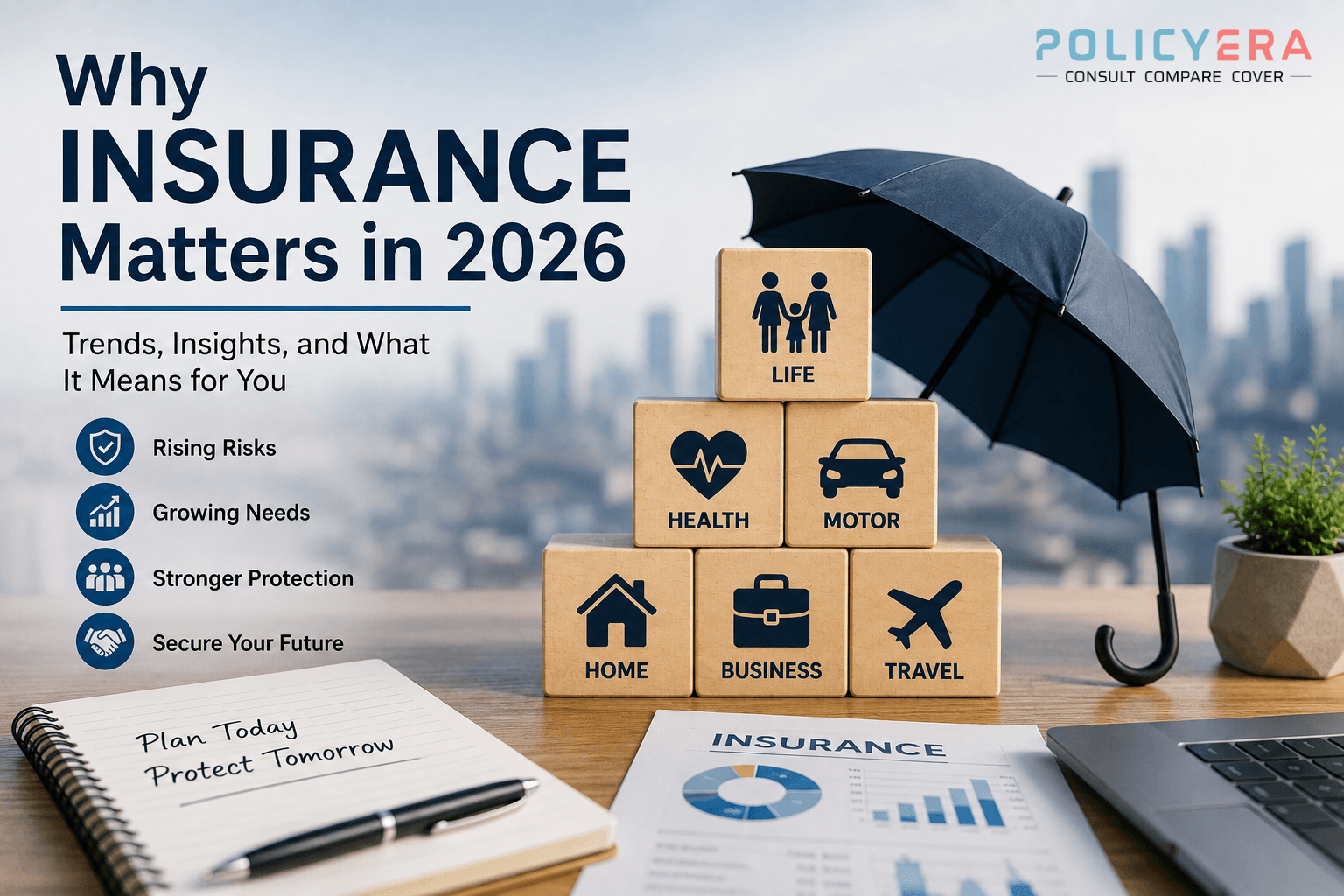
A professional insurance visual showing why insurance matters in 2026, highlighting rising risks, growing insurance needs, stronger protection, and future financial security across life, health, motor, home, business, and travel insurance.
As India progresses through 2026, insurance has evolved from being a peripheral financial product to a central pillar of long term financial security. Rising healthcare costs, economic volatility, climate related disruptions, and increasing life expectancy have reshaped how families, professionals, and businesses perceive risk. Insurance today is no longer driven by compliance or tax planning alone. It is a deliberate strategy to protect stability, continuity, and future aspirations.
This shift is taking place alongside a rapidly transforming insurance sector marked by regulatory strengthening, digital adoption, product innovation, and growing consumer awareness. Understanding why insurance matters in this environment is essential for making informed and responsible financial decisions.
INSURANCE AS A SAFEGUARD FOR LIFE GOALS
In 2026, insurance functions as a protective framework for life goals rather than a reactive safety net. It supports education planning, retirement security, healthcare access, business continuity, and wealth protection across generations.
For families, insurance helps preserve income and ensures timely access to quality healthcare during unforeseen events. For individuals, it provides the confidence to pursue career growth, entrepreneurship, and asset ownership without exposing dependants to financial distress. For businesses, insurance protects employees, leadership, and operational assets against unexpected disruptions that can otherwise threaten long term viability.
The true value of insurance lies in the financial certainty and emotional reassurance it provides across different life stages.
KEY INSURANCE TRENDS SHAPING 2026
Several structural trends are redefining the insurance landscape in India.
Health insurance penetration continues to rise as medical inflation outpaces general inflation and private healthcare expands. Comprehensive policies are becoming more common, but they also require greater awareness of coverage limits, exclusions, and waiting periods.
Another major trend is the move towards customised insurance solutions. Insurers increasingly offer modular covers, riders, and top up options designed around age, profession, lifestyle, and specific risk exposure. This flexibility allows consumers to align insurance more closely with real world needs.
Digitalisation is improving policy access, servicing efficiency, and claims transparency. At the same time, it has increased the importance of accurate disclosures and documentation, making informed guidance more valuable than ever.
Regulatory reforms continue to strengthen policyholder protection, solvency norms, and disclosure standards, reinforcing trust and accountability across the sector.
PROJECTED SECTOR GROWTH AND ITS IMPLICATIONS
India’s insurance market is projected to grow faster than most major global markets over the coming years. A large underinsured population, rising incomes, urbanisation, and increased participation from younger consumers are driving this momentum.
Life and health insurance are expected to see sustained demand as longevity increases and traditional family support systems evolve. Non life insurance segments such as motor, cyber, professional liability, and business insurance are also expanding with economic formalisation and digital exposure.
For consumers, this growth translates into wider choice and innovation. However, it also places greater responsibility on individuals and businesses to assess suitability, understand policy wordings, and choose coverage based on needs rather than price alone.
WHY INSURANCE DECISIONS MUST BE RETHOUGHT IN 2026
Relying on minimum premiums or generic covers is increasingly risky. Medical expenses continue to rise sharply, making inadequate health insurance a significant financial vulnerability. Similarly, insufficient life cover may fail to provide meaningful protection for dependants over time.
Insurance planning must be dynamic. Life events such as marriage, parenthood, property acquisition, career changes, or business expansion necessitate periodic reassessment of coverage adequacy.
Equally important is understanding claims related conditions. Awareness of exclusions, sub limits, deductibles, and documentation requirements helps prevent disputes and ensures smoother claims experiences.
INSURANCE FOR BUSINESSES AND PROFESSIONALS
For businesses in 2026, insurance is a core element of governance and risk management. Covers such as employee health insurance, professional indemnity, cyber insurance, and directors and officers liability are no longer optional safeguards but operational necessities.
Small and medium enterprises face increased exposure to regulatory scrutiny, contractual risks, and data security threats. Appropriate insurance enables continuity, protects cash flows, and enhances credibility with stakeholders.
Professionals including doctors, consultants, architects, and technology service providers rely on specialised insurance to manage legal and reputational risks arising from their professional responsibilities.
THE HUMAN VALUE OF BEING INSURED
Beyond financial protection, insurance plays a vital human role. It reduces uncertainty during medical emergencies, preserves dignity in treatment decisions, and prevents families from resorting to asset liquidation or high interest borrowing during crises.
For businesses, insurance protects livelihoods by supporting recovery rather than closure after setbacks. This emotional and social impact often becomes visible only when adequate protection is absent.
HOW POLICY ERA SUPPORTS SMARTER INSURANCE DECISIONS
Navigating the modern insurance ecosystem requires clarity, comparison, and informed guidance. Policy Era operates as an insurance advisory and facilitation platform that helps individuals and businesses understand, compare, and select insurance solutions aligned with their needs.
Policy Era supports consumers by simplifying complex policy information, assisting with coverage evaluation, and offering guidance across life, health, and general insurance categories. Its approach focuses on suitability, transparency, and long term protection rather than transactional selling.
Through digital tools, expert assistance, and claims support services, Policy Era helps policyholders make informed choices while staying aligned with regulatory standards and policy conditions.
MAKING INSURANCE WORK FOR YOU IN 2026
To derive meaningful value from insurance, consumers should take a proactive approach.
This includes regularly reviewing coverage, aligning policies with income and life stage changes, understanding policy terms, and choosing advisors who prioritise service quality and long term engagement.
Insurance should be viewed as an integral part of holistic financial planning rather than an isolated annual purchase.
CONCLUSION
In 2026, insurance stands at the intersection of protection, planning, and preparedness. As risks grow more complex and aspirations more ambitious, insurance offers stability in an increasingly uncertain environment.
With strong sector growth, evolving products, and enhanced regulatory oversight, consumers have greater opportunity to secure meaningful protection. When supported by informed guidance platforms such as Policy Era, insurance becomes a strategic tool for safeguarding families, businesses, and future goals.
Insurance coverage is subject to policy terms and conditions. Individuals are advised to assess their needs and review policy documents carefully before making decisions.
FAQs
1. Is Insurance a Good Career Choice Right Now?
Yes, insurance can be a strong career choice in 2026. The industry is expanding with increasing demand for health, life, motor, business, cyber, and professional insurance. Digitalisation and changing customer needs are also creating opportunities in sales, underwriting, claims, risk management, customer service, and insurance technology. It can be particularly suitable for people who want a career with multiple specialisations and long-term growth opportunities.
2. Why Is Insurance Less Competitive Than Tech and Finance?
Insurance can appear less competitive than technology and finance because it often receives less attention from students and young professionals. However, the industry offers diverse career paths across underwriting, claims, actuarial science, risk management, broking, sales, compliance, and technology. As insurance adoption increases, professionals with specialised knowledge and strong communication or analytical skills can find meaningful opportunities.
3. What Insurance Jobs Are Actually Hiring?
Insurance companies, brokers, and insurance technology businesses hire for a wide range of roles. Common opportunities include insurance sales, relationship management, underwriting, claims processing, customer support, risk assessment, actuarial roles, compliance, digital marketing, data analytics, and insurance technology. Entry-level candidates can begin with sales, operations, customer service, or support roles, while experienced professionals can move into specialised and managerial positions.
4. Why Am I Losing Health Insurance When I Leave My Job?
Employer-provided health insurance is generally linked to your employment, so coverage may end when you leave the organisation, depending on the terms of the employer policy. This can create a coverage gap if you do not arrange alternative protection. Before leaving a job, check when your employer coverage ends and explore individual or family health insurance options to maintain continuous protection.
5. How Much Does Health Insurance Cost Without an Employer?
The cost of individual health insurance depends on factors such as age, location, coverage amount, medical history, policy features, and the number of people covered. Without employer support, you are responsible for the full premium. Comparing policies based on coverage, exclusions, waiting periods, deductibles, and claim conditions rather than premium alone can help you choose suitable protection.
6. Can I Afford Insurance on a Part-Time Job Income?
Yes, insurance can still be considered when you have a limited or part-time income. The key is to prioritise essential coverage and select a policy that fits your budget without compromising important protection. Comparing different plans, coverage amounts, deductibles, and payment options can help manage costs. As your income increases, you can periodically review and increase your coverage based on your changing needs.