Health Insurance
Is It Covered? Health Insurance Coverage in India: Robotic Surgery, Non-Medical Expenses & Mental Health
A woman thinks about health insurance coverage for robotic surgery non medical expenses and mental health. Checklist shows treatment hospitalisation cashless facility and claim support by PolicyEra
When people buy health insurance, one question matters more than almost anything else: “Is it covered?”
Searches such as “Can I claim?”, “Is X covered?”, “Does health insurance cover this treatment?”, and “What expenses are not covered?” reflect high-intent questions from people who are either comparing policies or preparing for a medical claim.
For insurers and health-insurance websites, these are also valuable Answer Engine Optimization (AEO) and Generative Engine Optimization (GEO) opportunities because search engines and AI systems increasingly look for direct, structured answers to specific questions.
The answer, however, is rarely a simple “yes” or “no”. Coverage can depend on medical necessity, policy wording, waiting periods, sub-limits, deductibles, co-payments, room-rent limits, exclusions, network-hospital rules and whether an add-on is required.
This guide answers three important conditional health-insurance queries:
1. Is robotic knee replacement covered by health insurance in India?
2. What are non-medical expenses not covered in health insurance?
3. Does health insurance cover depression therapy and psychiatric admission?
Quick answer: Modern treatments such as robotic surgery are generally not supposed to be excluded merely because they use advanced technology, but the amount payable can still be subject to the policy's terms, sub-limits and other applicable conditions. Non-medical expenses may be excluded or treated differently under the applicable List I–IV framework. Mental-health treatment must be covered on the same basis as physical illness, subject to the policy's applicable terms and coverage structure.
Is Robotic Knee Replacement Covered by Health Insurance in India?
Yes, robotic surgery is among the modern treatment methods that health insurance policies are required to cover where medically indicated, but the amount payable depends on the specific policy's terms, including applicable sub-limits, co-payments and other conditions.
IRDAI's framework for modern treatment methods includes robotic surgeries, along with treatments such as oral chemotherapy, immunotherapy by injection, intra-vitreal injections, stereotactic radio surgeries and other advanced procedures. IRDAI's stated objective is to ensure that policyholders are not denied health-insurance coverage simply because a medically indicated treatment uses a modern technology.
Therefore, if a doctor recommends a robotic knee replacement, the fact that the surgery is performed using robotic assistance does not automatically make the claim inadmissible.
However, “covered” does not necessarily mean “paid in full.”
Robotic Knee Replacement: What Determines the Claim Amount?
A robotic knee replacement claim may be affected by:
• Sum insured available under the policy
• Modern-treatment sub-limit, if applicable
• Room-rent or ICU limits
• Co-payment
• Deductible
• Waiting period
• Pre-existing disease provisions
• Policy exclusions
• Hospital and treatment eligibility
• Consumables or other non-payable expenses
• Whether the procedure meets the policy's definition of a covered treatment
IRDAI explains that a sub-limit is a predefined limit for a specific condition, treatment, service or situation, beyond which the insurer will not pay.
Robotic Surgery Coverage: Condition vs Coverage Status
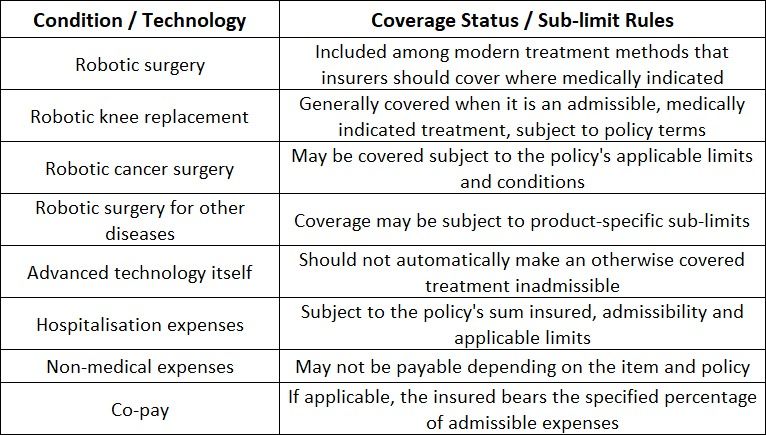
Important: The exact financial limit is policy-specific. Do not assume that every insurer pays the entire robotic-surgery bill simply because robotic surgery appears in the modern-treatment framework.
For example, historical policy documents have used different sub-limits for robotic surgeries. One United India policy document provided different percentages of sum insured depending on the condition being treated, illustrating why consumers should check the actual policy wording rather than relying on the treatment name alone.
Example: How a Robotic Knee Replacement Claim Can Be Reduced
Suppose:
• Sum insured = ₹10 lakh
• Hospital bill = ₹7 lakh
• Robotic surgery sub-limit = ₹5 lakh
• Other admissible hospital expenses = ₹2 lakh
If the policy imposes a ₹5 lakh limit specifically on the robotic procedure, the insurer may not simply pay the full ₹7 lakh. The final settlement would depend on how the policy defines the sub-limit and which components of the bill fall within it.
This is why “Is robotic surgery covered?” and “How much of robotic surgery is covered?” are two different questions.
What Are Modern Treatment Methods Covered by Health Insurance?
IRDAI's modern-treatment framework identifies 12 modern treatment methods and advancements in technology. These include:
-
Uterine artery embolization and HIFU
-
Balloon sinuplasty
-
Deep brain stimulation
-
Oral chemotherapy
-
Immunotherapy using monoclonal antibodies by injection
-
Intra-vitreal injections
-
Robotic surgeries
-
Stereotactic radio surgeries
-
Bronchial thermoplasty
-
Vaporisation of the prostate using green laser or holmium laser treatment
-
Intra-operative neuro monitoring (IONM)
-
Stem-cell therapy involving hematopoietic stem cells for bone-marrow transplantation for specified haematological conditions
The important AEO point is that technology-based treatments should not be treated as automatically excluded simply because they are modern or advanced. At the same time, coverage remains subject to the applicable policy contract, medical indication and product design, including permitted sub-limits.
Can I Claim for Robotic Surgery If My Policy Does Not Specifically Mention It?
Possibly, depending on the applicable policy and regulatory framework. The absence of a marketing reference to robotic surgery does not by itself answer the claim question.
The correct approach is to check:
• The policy wording
• Coverage for modern treatment methods
• Applicable sub-limits
• Exclusions
• Waiting periods
• Co-payment
• Medical necessity
• Pre-authorisation requirements
A policyholder should request written clarification from the insurer or TPA before undergoing an expensive planned procedure whenever possible.
What Are Non-Medical Expenses Not Covered in Health Insurance?
Non-medical expenses are hospital-related charges that may not be payable as a separate claim component, depending on their classification and the policy wording. Examples can include gloves, certain personal-comfort items, administrative charges, documentation-related expenses and other specified items.
IRDAI's standardisation framework divides these expenses into List I, List II, List III and List IV. Importantly, the four lists do not all mean “automatically rejected.”
List I contains optional items that insurers may choose to cover. Lists II, III and IV identify expenses that are to be subsumed into room charges, procedure charges or treatment costs respectively. This distinction is extremely important when explaining a health-insurance deduction to a customer.
IRDAI List I–IV Non-Medical Expense Breakdown
1. List I – Optional Items
List I contains items that may be treated as optional items. Insurers may offer coverage for these items depending on the policy.
Examples include:
• Baby food
• Beauty services
• Belts and braces
• Carry bags
• Internet or email charges
• Laundry charges
• Mineral water
• Telephone charges
• Guest services
• Attendant charges
• Medical-record charges
• Photocopy charges
• Walking aids
• Gloves
• Masks
• Ambulance equipment
• Certain nursing or special-service charges
The actual list and whether an item is payable must be checked against the applicable policy wording.
2. List II – Items Subsumed Into Room Charges
These items are intended to form part of the room charges rather than being billed separately. Examples include:
• Hand wash
• Shoe covers
• Caps
• Gowns
• Slippers
• Tissue paper
• Toothpaste
• Toothbrush
• Bed pan
• Face masks
• Housekeeping charges
• Air-conditioning charges
• Documentation or administrative expenses
• File-opening charges
• Discharge procedure charges
• Patient identification bands
IRDAI's framework states that such costs are to be subsumed into the relevant room charges.
3. List III – Items Subsumed Into Procedure Charges
List III covers items that should form part of the charges for the relevant procedure. Examples include:
• Surgical blades
• Gauze
• Cotton
• Surgical tape
• Eye pads
• Eye drapes
• Surgical drills
• Arthroscopy and endoscopy instruments
• Microscope covers
• Theatre-related charges
• Aprons
• Tourniquets
These should generally be considered as part of the relevant procedure cost rather than automatically treated as separate non-payable expenses.
4. List IV – Items Subsumed Into Treatment Costs
List IV contains expenses that are to be subsumed into the costs of treatment. Examples include:
• Admission and registration charges
• Infusion pump costs
• Disinfectants
• Dietician and nutrition-planning charges
• HIV kits
• Antiseptic mouthwash
• Vaccination charges
• Alcohol swabs
• Glucometer and strips
• Urine bags
• Certain diagnostic-related expenses
IRDAI specifies that costs falling under List IV are to be treated as part of the costs of treatment, subject to the terms and conditions of the policy contract.
Are Gloves, Syringes and PPE Covered by Health Insurance?
It depends on the specific item, its classification, the policy wording and how the hospital has billed it.
For example, IRDAI's List I includes gloves among optional items. Therefore, a policyholder should not assume that every consumable appearing on a hospital bill will automatically be reimbursed.
At the same time, some items classified under Lists II–IV are intended to be incorporated into the relevant room, procedure or treatment charges.
Why Does a Health Insurance Claim Show a Non-Medical Deduction?
A deduction can occur because:
-
The item is listed as an optional expense.
-
The policy does not include the relevant optional cover.
-
The hospital has billed an expense separately even though it should form part of another charge.
-
A policy-specific exclusion applies.
-
A sub-limit or co-payment affects the payable amount.
-
The expense is outside the definition of admissible treatment costs.
This is why “non-medical expense” does not always mean “everything the hospital calls a consumable.”
Is a Consumables Add-On Worth It?
It can be valuable for policyholders who want to reduce out-of-pocket deductions from hospital bills, but the value depends on the add-on's terms, exclusions, premium and the base policy.
A consumables add-on may cover selected items that would otherwise be excluded under the base policy.
Before purchasing one, check:
• Which consumables are covered?
• Is there a list of excluded items?
• Is there a separate limit?
• Does it cover gloves, PPE and syringes?
• Does it cover all hospital consumables or only specified items?
• Does it apply to cashless claims?
• Does it cover reimbursement claims?
• Is there a waiting period?
• What additional premium is charged?
Do not assume that buying a “consumables cover” means every non-medical expense becomes payable.
Does Health Insurance Cover Depression Therapy and Psychiatric Admission?
Mental illness is required to receive health-insurance treatment on the same basis as physical illness under Section 21(4) of the Mental Healthcare Act, 2017, subject to the applicable policy terms. However, inpatient psychiatric treatment and outpatient therapy are not necessarily covered in exactly the same way.
The Mental Healthcare Act, 2017 states that insurers must make provision for medical insurance for treatment of mental illness on the same basis as treatment for physical illness.
IRDAI has directed insurers to comply with this requirement, and its 2024 health-insurance master circular requires insurers to offer products covering different medical conditions while complying with laws including the Mental Healthcare Act, 2017.
Q&A: Mental Health Insurance Coverage
Is psychiatric hospitalisation covered by health insurance?
Yes, mental illness treatment is required to be covered on the same basis as physical illness, subject to the applicable policy terms.
If a policy provides hospitalisation coverage for physical illnesses, mental-health hospitalisation should be considered within the applicable mental-health coverage framework.
Does health insurance cover depression?
Depression can fall within mental-health coverage, subject to the policy's definition of mental illness and applicable terms and conditions.
However, policyholders should check:
• Whether the treatment is medically necessary
• Whether hospitalisation is required
• Waiting-period provisions
• Pre-existing disease provisions
• Applicable sub-limits
• Co-payment
• Room eligibility
• Exclusions
• Whether the treatment is inpatient or outpatient
Does health insurance cover depression therapy?
It can, but outpatient therapy is not automatically identical to inpatient hospitalisation coverage.
The distinction matters because a health policy may provide hospitalisation coverage while offering separate OPD, counselling or wellness benefits.
The Government stated in February 2026 that policies offering OPD treatment for physical illness must cover mental illness on the same basis, and that various products provide benefits such as therapy, counselling, psychiatric consultation and outpatient support according to their terms and conditions.
Is a psychologist consultation covered?
It depends on the policy's benefits and whether outpatient mental-health services are included.
Check whether the policy specifically provides:
• OPD consultation
• Psychological counselling
• Psychiatric consultation
• Therapy sessions
• E-counselling
• Wellness benefits
Do not confuse the legal requirement for parity in mental-health insurance with a guarantee that every health-insurance plan provides unlimited cashless therapy sessions.
Can I Claim Mental Health Treatment If I Already Have a Policy?
You may be able to claim, but eligibility depends on the policy in force, the date of treatment, continuity of coverage and the applicable terms.
For a claim, insurers may examine:
• Diagnosis
• Medical necessity
• Treatment records
• Hospitalisation details
• Prescriptions
• Bills
• Policy coverage
• Waiting periods
• Pre-existing disease provisions
• Applicable limits and co-payment
For a planned psychiatric admission, obtaining pre-authorisation from the insurer or TPA can help establish whether the proposed hospitalisation is covered before substantial expenses are incurred.
Is It Covered? Does Not Always Mean “Will the Insurer Pay the Entire Bill?
This is one of the most important concepts for health-insurance consumers.
There are at least five separate questions:
1. Is the treatment covered?
This determines whether the treatment falls within the policy's insured benefits.
2. Is the treatment medically necessary?
Some policies require treatment to meet their definition of medically necessary care.
3. Is there a sub-limit?
A treatment can be covered but have a separate monetary ceiling.
4. Is there a co-payment?
The policyholder may have to pay a specified percentage of the admissible claim.
5. Are all components of the bill payable?
Even when the main treatment is covered, certain optional or non-payable expenses may not be reimbursed.
Therefore: Covered ≠ Unlimited coverage ≠ Full hospital bill reimbursement.
How to Check Whether a Treatment Is Covered Before Hospitalisation
Before undergoing an expensive planned treatment, follow this simple process.
Step 1: Identify the exact treatment
Do not rely only on the common name.
For example: “Knee replacement” may need to be clarified as “robotic-assisted total knee replacement.”
Step 2: Check the policy wording
Look for:
• Coverage section
• Modern treatment section
• Exclusions
• Sub-limits
• Co-payment
• Deductible
• Waiting periods
• Day-care definition
Step 3: Check the hospital
Confirm whether the hospital is part of the insurer's network if you want to use cashless treatment.
Step 4: Ask for pre-authorisation
For planned procedures, ask the insurer/TPA to confirm admissibility and applicable limits.
Step 5: Ask about non-medical expenses
Request an estimate of expenses that may remain payable by you.
Step 6: Check the final claim settlement
Compare: Hospital bill → admissible amount → deductions → insurer payment → your out-of-pocket amount
What Should You Check in Your Health Insurance Policy?
Before buying or renewing a policy, use this “Is It Covered?” checklist:
• Treatment coverage: Is the procedure explicitly covered?
• Modern treatments: Are advanced treatments included?
• Sub-limits: Is there a separate limit for robotic surgery or another treatment?
• Room rent: Is there a room-category restriction?
• Co-pay: Do you have to share a percentage of the claim?
• Deductible: Is a fixed amount payable before insurance starts?
• Waiting period: Has the applicable waiting period been completed?
• Pre-existing disease: Does the condition qualify as a PED?
• Non-medical expenses: Which items remain your responsibility?
• Consumables: Is there a consumables add-on?
• OPD: Are consultations and therapy covered?
• Mental health: Are inpatient and outpatient benefits clearly defined?
• Cashless: Is your preferred hospital in the insurer's network?
• Pre-authorisation: Is prior approval required?
FAQs
1.Can I claim robotic knee replacement under health insurance?
Yes, robotic surgery is included among modern treatment methods that health insurers are required to cover where medically indicated, but the payable amount may be subject to policy-specific sub-limits, co-payment, deductibles and other terms.
2. Is robotic surgery fully covered by health insurance?
Not necessarily. Robotic surgery may be covered, but a policy can impose applicable limits or other cost-sharing conditions. Always check the policy wording.
3. What are non-medical expenses in health insurance?
Non-medical expenses are specified hospital-related costs that may be optional or may need to be included within room, procedure or treatment charges under the applicable IRDAI framework. Examples include certain personal-comfort items, administrative charges and consumables.
4. Does health insurance cover psychiatric hospitalisation?
Yes, mental illness must receive insurance treatment on the same basis as physical illness under the Mental Healthcare Act, 2017, subject to the applicable policy terms.
5. Does health insurance cover psychologist consultations?
Some policies provide OPD or counselling benefits, but coverage is policy-specific. Check whether psychologist consultation or therapy is expressly included.
6. Can I claim non-medical expenses?
Some optional items may be covered if the policy provides the relevant benefit. Other expenses are treated as part of room, procedure or treatment costs under the applicable framework rather than being separately payable.
7. Are gloves covered by health insurance?
Not automatically. Gloves appear in List I of the IRDAI standardised list of optional items, so their treatment depends on the policy and whether optional coverage is provided.
8. Is Robotic Surgery Covered by Health Insurance in India?
Yes, robotic surgery is covered by health insurance in India when it is medically indicated and covered under the applicable policy terms. However, the payable amount may depend on the sum insured, sub-limits, co-payment, deductibles, waiting periods, exclusions and other policy conditions.
9. How Much Does Robotic Surgery Cost in India Without Insurance?
The cost of robotic surgery without insurance can vary depending on the type of surgery, hospital and treatment requirements. Before undergoing the procedure, patients should confirm the estimated hospital cost and check whether their health insurance policy provides coverage for the treatment.
10. Can I Claim Health Insurance for Robotic Surgery?
Yes, you can claim health insurance for robotic surgery if the treatment is medically necessary and meets the coverage conditions of your policy. The final claim amount may be affected by sub-limits, co-payment, deductibles, waiting periods, exclusions and non-medical expenses. For planned surgery, it is advisable to check the policy wording and obtain pre-authorisation from the insurer or TPA where applicable.