IRDAI Distribution Reforms 2026: What Do They Mean for Insurance Buyers?
Corporate executives in formal wear seated around a conference table for an IRDAI distribution reforms meeting.
IRDAI’s proposed 2026 distribution reforms aim to reduce excessive distribution costs, introduce product- and channel-specific commission limits, tighten insurers’ Expenses of Management (EoM), simplify the distribution structure and strengthen safeguards against insurance mis-selling.
However, these changes are proposals, not final rules yet. The Insurance Regulatory and Development Authority of India (IRDAI) released its two-part consultation paper, “Recalibrating Economics of Insurance Distribution,” on 23 September 2026. Stakeholders have been invited to submit comments by 25 October 2026.
For customers, the central question is simple:
Will lower commissions actually make insurance cheaper and reduce mis-selling?
The answer is not automatic. Lower distribution costs could create room for better pricing, but the final premium paid by customers will still depend on insurers’ claims costs, risk pricing, operating expenses, taxes and competition.
The proposed framework is nevertheless significant because it attempts to change how insurance is sold, how distributors are paid and how customer interests are protected.
What Are IRDAI’s New Distribution Reforms?
IRDAI’s proposed distribution reforms broadly focus on four areas:
-
Lower and product-specific insurance commission limits
-
A phased reduction in insurers’ Expenses of Management
-
A simpler distribution architecture involving IDEs, IDPs and Market Infrastructure Institutions
-
Stronger safeguards against mis-selling, forced bundling and incentive-driven sales
The regulator's consultation paper proposes linking distributor remuneration to factors such as the insurance segment, product complexity, distribution channel and effort involved in selling and servicing the product.
This represents a significant shift from the framework introduced in 2023, when product-level commission caps were removed and insurers operated under an overall EoM framework.
IRDAI has pointed to rapid growth in distributor remuneration compared with premium growth as one reason for reconsidering the framework. For example, reported data from the consultation process indicates that remuneration in certain distribution channels grew substantially faster than premiums between FY23 and FY25.
What Is the IRDAI EoM Limits Glide Path?
EoM means Expenses of Management. It broadly covers the expenses incurred by an insurer in running and distributing its insurance business, including relevant distribution and remuneration costs.
Under the proposed IRDAI EoM limits glide path, insurers would have to progressively reduce their permitted expenses over a five-year period.

The proposed framework therefore does not simply put a ceiling on an individual agent’s commission. It also seeks to control the insurer’s overall distribution and management cost structure.
Why is the EoM glide path important?
Suppose an insurer currently spends a relatively high percentage of premium income on distribution and administration.
If the permitted expense level gradually falls, the insurer may need to:
• negotiate lower distribution costs;
• improve digital sales;
• reduce inefficient acquisition expenses;
• improve operational efficiency;
• redesign distributor incentives;
• increase direct or technology-enabled distribution; and
• compete more strongly on customer value.
However, a lower EoM does not automatically mean an equivalent reduction in your premium. That distinction is important.
Insurance premiums are also influenced by claims, underwriting risk, reinsurance, operating expenses, product benefits and market competition.
Will IRDAI’s Commission Limits Make Insurance Cheaper?
Possibly, but there is no guarantee that lower commissions will translate one-for-one into lower premiums.
The proposed framework introduces product- and channel-specific commission ceilings. For example, reported proposals include:
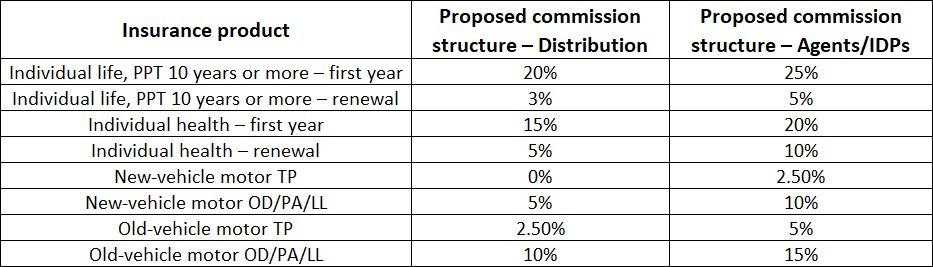
These are proposed limits, and the final framework may change following consultation.
The underlying idea is to make remuneration more closely related to the work required to sell and service the product.
For a relatively simple product sold to a customer who already understands the cover, IRDAI appears to be questioning whether very high acquisition remuneration is justified.
For customers, this could eventually improve cost efficiency. But the important word is eventually.
How Could Lower Commissions Affect Your Insurance Premium?
Consider a simplified example.
Suppose an insurance premium is ₹20,000.
If the distributor receives ₹6,000 as remuneration, the distribution cost represents 30% of the premium.
If the permitted remuneration eventually falls to ₹3,000, there is ₹3,000 less distribution expenditure.
But that does not mean the customer's premium automatically falls from ₹20,000 to ₹17,000.
The insurer could use the saving to:
• reduce operating costs;
• strengthen reserves;
• improve technology;
• manage claims costs;
• increase profitability;
• invest in customer service; or
• compete through pricing.
Therefore, IRDAI’s distribution reforms create the possibility of lower costs, but they do not guarantee cheaper insurance premiums.
The real consumer test will be whether competition and regulatory monitoring cause part of those efficiency gains to reach policyholders.
How Will IRDAI’s New Rules Address Insurance Mis-Selling?
The proposed insurance mis-selling rules IRDAI framework goes beyond commission caps. The consultation paper proposes stronger accountability for how insurance is sold.
Some of the proposed measures include:
• linking a policy to the identity of the individual seller;
• documenting customer needs and suitability for specified life insurance sales;
• bringing direct and indirect remuneration within the commission framework;
• restricting volume-linked or reward-linked incentives for bank and NBFC employees;
• allowing commission clawbacks where mis-selling is established;
• improving commission disclosures;
• addressing digital dark patterns; and
• increasing transparency around insurance distribution.
The proposals are intended to shift incentives away from simply acquiring policies and towards more suitable and transparent sales.
What counts as potential mis-selling?
Examples discussed in the regulatory context include:
• presenting an insurance product as if it were a fixed deposit;
• describing a market-linked insurance product as a guaranteed-return product;
• failing to explain surrender consequences;
• not clearly explaining the premium commitment;
• selling an unsuitable product based primarily on commission;
• making insurance appear compulsory when it is not;
• using misleading digital interfaces or “dark patterns”.
The proposed framework is particularly relevant to long-term life insurance because customers can suffer significant financial consequences if they discontinue an unsuitable policy early.
Can Banks Force You to Buy Insurance With a Home Loan? IRDAI Rules Explained
Generally, a bank or lender should not make an insurance purchase a compulsory condition simply for granting a loan where such bundling is prohibited by the applicable regulatory framework.
IRDAI has previously addressed complaints involving banks and NBFCs allegedly forcing customers to purchase insurance while obtaining housing or other loans.
In a 2016 communication, IRDAI specifically highlighted complaints involving compulsory bundling of insurance with loans and stated that compelling customers to buy insurance was prohibited under the applicable corporate-agent framework.
The 2026 consultation proposes strengthening this principle further.
The proposed framework would prevent lenders from making insurance compulsory as a condition for granting a loan, subject to the framework's provisions. Where insurance is offered as part of a package, the proposal includes greater transparency around the loan economics and customer choice.
What should you do if a lender says insurance is mandatory?
Ask the lender to provide the requirement in writing.
You can ask:
-
Is the insurance legally mandatory?
-
What exact insurance cover is required?
-
Can I purchase the required cover from another insurer?
-
Is the premium being added to my loan?
-
What is the loan interest rate with and without the insurance?
-
Is the insurance being offered by the lender's group company or another entity?
-
What alternatives are available?
Do not rely solely on a verbal statement.
If you believe you have been mis-sold or forced to buy an insurance policy, you can first approach the insurer's grievance redressal mechanism and, where necessary, escalate through IRDAI's Bima Bharosa grievance platform. IRDAI states that complaints can be registered through Bima Bharosa and tracked using a token number.
What Is the Difference Between IDE and IDP in Insurance?
One of the major proposed changes is a simpler insurance distribution architecture.
Insurance Distribution Entity (IDE)
An Insurance Distribution Entity (IDE) would broadly cover organisational entities involved in insurance distribution, including categories such as banks, brokers, corporate agents, composite brokers, insurance marketing firms and web aggregators, subject to the final regulatory structure.
Insurance Distribution Person (IDP)
An Insurance Distribution Person (IDP) would refer broadly to individuals or persons associated with insurance distribution, including agents, insurance associates and Point of Sales Persons (PoSPs), depending on the final framework.
IDE vs IDP: Simple Difference

The proposed framework also contemplates different architecture and insurer relationships depending on the type of distributor.
In simple words:
An IDE is the organisation; an IDP is the person involved in distributing insurance.
Because the framework is still under consultation, the exact legal scope and operational requirements should be checked against the final regulations once notified.
Bima Sugam Insurance Platform: What Does It Mean for Customers?
Bima Sugam is envisaged as a digital insurance marketplace designed to make insurance buying and servicing more interoperable and transparent.
IRDAI notified the Bima Sugam – Insurance Electronic Marketplace Regulations, 2024, establishing the regulatory foundation for the marketplace.
As of September 2026, Bima Sugam is expected to become an important part of the broader insurance distribution ecosystem. Recent reporting indicates that IRDAI expects the marketplace to go live around November 2026, although implementation timelines can change.
For customers, the potential benefits include:
• easier comparison;
• digital purchase;
• greater transparency;
• easier access to policy information;
• reduced dependence on a single distributor;
• improved portability of information;
• digital servicing; and
• potentially lower distribution costs.
The proposed distribution framework also connects Bima Sugam and other Market Infrastructure Institutions with the wider insurance ecosystem.
How Much Commission Do Motor Dealers Make on Car Insurance?
This is one of the most searched questions around the new reforms.
According to reporting based on IRDAI's consultation paper, motor insurance distribution has seen significant commission levels.
For FY25, OEM brokers and Motor Insurance Service Providers (MISPs) reportedly generated approximately ₹29,000 crore of premium and received nearly ₹7,050 crore in commissions. The consultation paper has highlighted an average motor insurance commission rate of around 24%, with rates varying significantly by business and distribution arrangement.
That does not mean every motor dealer earns 24% on every car insurance policy.
Actual remuneration can vary according to:
• insurer;
• vehicle type;
• new versus old vehicle;
• third-party versus own-damage cover;
• distributor structure;
• applicable remuneration rules; and
• the final regulatory framework.
The proposed commission structure is designed to bring much lower remuneration to certain motor insurance categories, particularly mandatory third-party insurance for new vehicles.
What Is the Motor Insurance MISP Commission Cap?
A Motor Insurance Service Provider (MISP) is an automobile dealer appointed by an insurer or intermediary to distribute and/or service motor insurance connected with vehicles sold through the dealer.
Existing IRDAI MISP guidelines had prescribed maximum distribution fees for MISPs, including limits of 22.5% of the own-damage portion for two-wheelers and 19.5% for other automobiles, subject to the applicable framework. The rules also prohibit MISPs from forcing customers to buy motor insurance through a particular insurer or intermediary.
The 2026 consultation proposes a new, broader distribution and commission structure. IRDAI has specifically highlighted motor insurance because it considers some motor products relatively easy to distribute while carrying substantial commissions. The consultation also discusses the role of OEM brokers and MISPs and proposes greater customer choice, including digital purchasing options.
What could change for car buyers?
A customer buying a new car may increasingly be able to:
• compare insurance outside the dealership;
• access digital insurance options;
• see alternative distribution channels;
• understand that dealer-arranged insurance is not necessarily the only option;
• compare premiums and coverage before purchasing.
The proposal also seeks safeguards so that customers are not disadvantaged merely because they purchase insurance through another channel.
New IRDAI Rules for Life Insurance Renewal Commissions
The proposed framework could significantly change how life insurance renewal commissions work. For individual non-linked and linked products with a premium-paying term of 10 years or more, the proposed structure includes:
• 20% first-year commission for distribution entities
• 25% first-year commission for agents
• 3% renewal commission for distribution entities
• 5% renewal commission for agents
For shorter premium-paying terms, the proposed first-year commission varies depending on the premium-paying period.
For individual pure-term insurance with multi-year premiums, the proposal also contains a separate commission structure, including renewal remuneration.
Why does renewal commission matter?
Renewal commissions can influence how distributors earn income after the original sale.
A customer should therefore focus on:
• whether the policy remains suitable;
• whether the cover amount is adequate;
• whether premiums remain affordable;
• whether policy benefits match the original requirement;
• exclusions and conditions;
• surrender implications; and
• policy persistency.
The purpose of insurance is not to maximise distributor remuneration. It is to provide appropriate financial protection.
Could These Reforms Reduce Insurance Mis-Selling?
They could reduce some incentives associated with commission-led selling, but regulation alone cannot eliminate mis-selling.
The proposed framework attacks the problem from several directions.
1. Lower commission ceilings
Lower remuneration can reduce the financial incentive to push certain products purely because they pay more.
2. Seller identification
Linking individual sellers to policies can make accountability easier to establish.
3. Commission clawbacks
The proposal contemplates clawbacks where mis-selling is established.
4. Suitability requirements
For specified products, documenting customer needs and suitability could create a stronger audit trail.
5. Restrictions on bank incentives
The proposal seeks to prohibit volume-linked and reward-linked incentives for bank and NBFC employees selling insurance.
6. Digital dark-pattern controls
Customers should not be manipulated through confusing interfaces, misleading buttons or unnecessary collection of personal information.
Together, these measures could make the economics of mis-selling less attractive and increase accountability.
What Should Insurance Buyers Do Differently?
Regulatory reform does not eliminate the need for consumers to compare policies.
Before buying insurance, consider these practical steps:
For health insurance
Check:
• sum insured;
• room-rent conditions;
• waiting periods;
• exclusions;
• co-payment;
• network hospitals;
• restoration benefits;
• sub-limits;
• claim process;
• renewal conditions.
For term insurance
Check:
• sum assured;
• policy term;
• premium payment term;
• exclusions;
• riders;
• premium affordability;
• claim settlement process;
• nominee details.
For car insurance
Compare:
• IDV;
• own-damage premium;
• third-party premium;
• deductibles;
• zero-depreciation cover;
• engine protection;
• roadside assistance;
• consumables cover;
• network garages;
• claim service.
Most importantly, compare the coverage, not just the premium.
A cheaper policy with significantly weaker coverage may not provide better value.
Will Existing Insurance Policies Change Because of These IRDAI Reforms?
Not automatically.
The September 2026 consultation paper concerns the proposed future framework for insurance distribution, commissions, expenses and market conduct.
Existing policyholders should not assume that their current policy terms, benefits or premiums will automatically change simply because the consultation paper has been released.
The effect on future policies, distribution arrangements and remuneration will depend on the final regulations and their implementation.
Therefore, if you already hold a policy, do not surrender or replace it merely because of headlines about commission reforms.
First compare:
• current benefits;
• surrender value;
• premium commitment;
• policy alternatives;
• replacement costs;
• waiting periods, where applicable;
• underwriting requirements; and
• financial consequences.
Are Lower Commissions the Same as Lower Insurance Premiums?
No.
This is perhaps the most important point for consumers.
Commission is only one part of the insurance economics.
A simplified insurance premium can be influenced by:
Risk + Expected Claims + Reinsurance + Operating Costs + Distribution Costs + Taxes + Other Regulatory/Business Costs
Therefore, reducing distribution commissions may reduce one component of the overall cost, but it does not mathematically guarantee an equivalent reduction in the premium.
The long-term consumer benefit could instead appear through:
• more competitive pricing;
• better product features;
• improved servicing;
• lower distribution costs;
• greater digital adoption;
• improved insurer efficiency; or
• stronger competition.
The final outcome will depend on how insurers and distributors respond to the reforms.
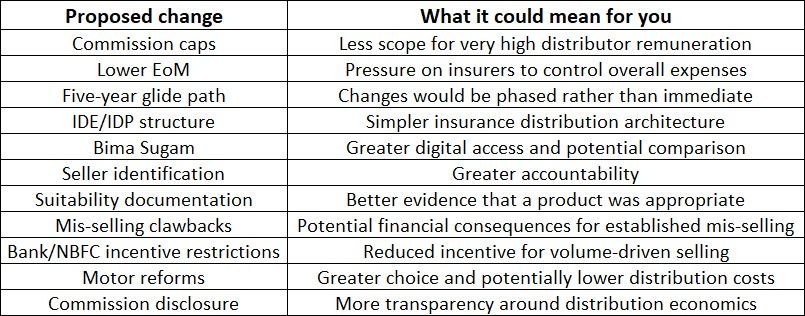
IRDAI Distribution Reforms 2026: Key Takeaways for Customers
Here is the entire proposal in simple terms:
What Do IRDAI’s Proposed Reforms Ultimately Mean for You?
IRDAI’s proposed distribution reforms are much broader than simply cutting insurance commissions.
They attempt to change the economics and behaviour of insurance distribution by combining:
• commission limits;
• tighter EoM controls;
• new distributor classifications;
• Bima Sugam and digital infrastructure;
• seller accountability;
• suitability requirements;
• restrictions on incentive-driven selling;
• greater transparency; and
• stronger safeguards against mis-selling.
For consumers, the potential benefit is a more transparent insurance market where the product is selected based more on need, suitability, coverage and price rather than the economics of the sales channel.
But it is too early to conclude that the reforms will automatically produce cheaper premiums. The proposals are still subject to consultation, and the final regulations may differ from the September 2026 consultation paper.
For now, the most useful approach for policyholders is simple: compare insurance policies independently, understand what you are buying, ask how the policy is being distributed, and never assume that the cheapest premium automatically provides the best protection.
If implemented substantially as proposed, the reforms could mark an important change in how insurance is sold in India—but the real test will be whether customers ultimately experience greater choice, clearer information, suitable products and better value.
FAQs
1. What are IRDAI distribution reforms?
IRDAI distribution reforms are proposed changes designed to regulate insurance distribution costs, introduce product- and channel-specific commission limits, reduce insurers’ EoM over a phased period, simplify distributor categories and strengthen safeguards against mis-selling.
2. Are IRDAI’s 2026 commission limits final?
No. As of 30 September 2026, they are proposals contained in a public consultation paper released on 23 September 2026. Stakeholder comments are invited until 25 October 2026.
3. Will insurance premiums become cheaper?
They may become more cost-efficient if lower distribution expenses are passed through competitive pricing, but IRDAI's proposed commission limits do not guarantee an equivalent reduction in premiums.
4. Can banks force you to buy insurance with a home loan?
Customers should not be compelled to purchase insurance merely as a condition of obtaining a loan where such compulsory bundling is prohibited. IRDAI has previously addressed complaints regarding forced insurance sales with loans and the 2026 proposals seek stronger safeguards.
5. What is an IDE in insurance?
IDE stands for Insurance Distribution Entity. It is proposed as a broad category for organisational insurance distributors such as banks, brokers, corporate agents and web aggregators, subject to the final framework.
6. What is an IDP in insurance?
IDP stands for Insurance Distribution Person. It broadly covers individuals involved in insurance distribution, such as agents, associates and PoSPs under the proposed structure.
7. What is Bima Sugam?
Bima Sugam is an IRDAI-regulated digital insurance marketplace framework intended to facilitate easier and more transparent insurance distribution and servicing.
8. How much commission do motor dealers make on car insurance?
There is no single commission rate applicable to every dealer and policy. IRDAI's 2026 consultation highlights average motor insurance commissions of around 24% in the relevant distribution data, while MISP remuneration and proposed future commission limits vary by vehicle, cover and distribution channel.
9. What is the MISP commission cap?
Existing MISP rules prescribed distribution-fee limits, including 19.5% of the own-damage portion for automobiles other than two-wheelers and 22.5% for two-wheelers. The 2026 consultation proposes a different, broader commission framework for motor insurance.
10. What are the proposed life insurance renewal commissions?
For individual non-linked and linked products with a premium-paying term of 10 years or more, the proposal provides for renewal commissions of 3% for distribution entities and 5% for agents, alongside proposed first-year limits of 20% and 25%, respectively.