
Vehicle Insurance
Motor & EV Insurance in India: Zero Depreciation, EV Battery Cover & NCB Transfer Guide
A banner showing cars on a city road with key motor and EV insurance covers.
Buying motor insurance is no longer simply about choosing the cheapest premium. For car owners in India, the right policy depends on how the vehicle is used, its age, repair costs, technology, and the risks that are most likely to create a large out-of-pocket expense.
This becomes especially important when comparing zero dep vs comprehensive insurance, choosing electric vehicle insurance, or moving your No Claim Bonus (NCB) from an old car to a new one.
In this guide, we answer three practical questions:
-
Is Zero Dep car insurance worth buying after 3 years?
-
Does standard car insurance cover EV battery replacement?
-
How do you transfer NCB to a new car step by step?
The answers depend on the policy wording, add-ons, vehicle age and insurer. IRDAI explains that comprehensive/package insurance can cover both third-party liability and damage to your own vehicle, while add-ons such as Nil Depreciation can extend the base coverage.
Which Motor Insurance Option Should You Choose?
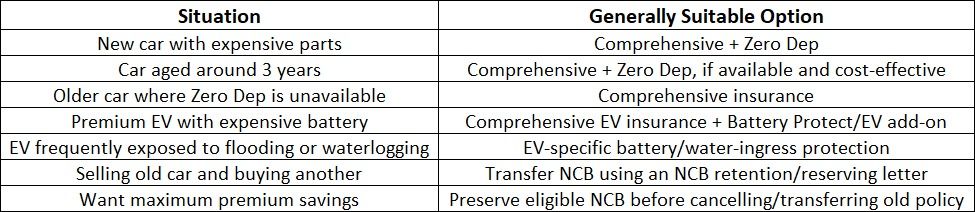
Important: Add-on availability, age limits, claim limits, deductibles and exclusions differ between insurers. Always check the policy schedule and wording before purchasing.
1. Zero Dep vs Comprehensive Insurance: When Is Zero Dep Worth It?
Target Query: Is Zero Dep car insurance worth buying after 3 years? Yes, Zero Dep can still be worth buying after 3 years if the additional premium is reasonable compared with the potential depreciation deduction on parts. However, it is not automatically the best choice for every three-year-old car.
The key difference is simple:
• Comprehensive insurance provides own-damage protection along with third-party liability, subject to policy terms.
• Zero Depreciation/Nil Depreciation is an add-on designed to reduce or waive applicable depreciation deductions on covered replaced parts during an admissible claim.
• Bumper-to-bumper car insurance is commonly used as another name for Zero Dep/Nil Dep insurance, although the exact coverage depends on the insurer's wording.
IRDAI lists Nil Depreciation as one of the common motor insurance add-ons and notes that add-ons extend the base policy for an additional premium.
What Is the Difference Between Zero Dep and Comprehensive Insurance?
Think of comprehensive insurance as the base protection, while Zero Dep is an additional layer.
Comprehensive Car Insurance
A comprehensive/package policy generally combines:
• Third-party liability cover
• Own-damage cover
• Protection against covered accidental damage
• Theft-related losses
• Fire and other covered perils
• Natural calamity-related damage, subject to policy terms
However, depreciation may be deducted from the value of certain parts replaced during an own-damage claim.
Zero Dep Car Insurance
Zero Dep is intended to address the depreciation component applicable to covered parts.
For example, suppose an accident damages several plastic and metal components. Under a standard own-damage claim, applicable depreciation may be deducted from replacement-part costs.
With an eligible Zero Dep add-on, the depreciation amount may be waived according to the add-on terms.
That can significantly reduce your out-of-pocket claim expense.
2. What Parts Have Depreciation in Standard Motor Insurance?
The commonly referenced standard depreciation schedule includes:
• Rubber, nylon and plastic parts: 50%
• Tyres and tubes: 50%
• Batteries: 50%
• Fibreglass components: 30%
• Glass parts: Nil depreciation
• Other parts: depreciation depends on the vehicle's age.
For other parts, the commonly specified age-based schedule is:
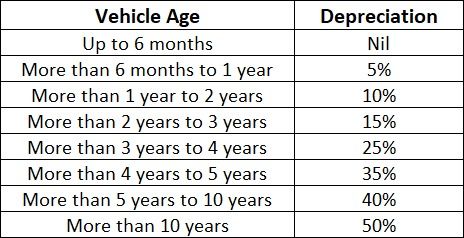
IRDAI's published motor policy wording contains these depreciation rates.
Note: These figures should be treated as a reference to the applicable policy framework and not as a guarantee that every current insurer's Zero Dep product will operate identically. Current product wording, exclusions and add-on conditions prevail.
3. Zero Dep Example: How Much Can You Save?
Imagine a three-year-old car has an accident.
The repair estimate includes:
• Plastic bumper: ₹20,000
• Metal component: ₹30,000
• Fibreglass component: ₹10,000
• Labour: ₹15,000
Under applicable depreciation rules, depreciation may be deducted from eligible parts.
The important point is that depreciation is not necessarily applied to every component in the same way.
For example, a 50% depreciation rate may apply to certain rubber/plastic components, while age-based depreciation can apply to other parts.
With a Zero Dep add-on, the eligible depreciation amount may be covered, subject to the policy's conditions.
Therefore, the economic benefit of Zero Dep becomes greater when:
Potential depreciation deduction > Zero Dep add-on premium
That is the basic financial logic behind deciding whether Zero Dep is worth purchasing.
4. Is Zero Dep Car Insurance Worth Buying After 3 Years?
For many drivers, yes—but compare the premium and eligibility first.
Zero Dep may be worth it if:
• Your car is around 3 years old and the add-on is still available.
• The vehicle has expensive plastic, fibreglass or other replacement components.
• You drive frequently in heavy traffic.
• You live in an area with higher accident or bumper-damage risk.
• You want to minimise unexpected repair expenses.
• The additional Zero Dep premium is relatively small compared with the potential depreciation deduction.
Comprehensive insurance without Zero Dep may make more sense if:
• The car is significantly older.
• The insurer does not offer Zero Dep for your vehicle age.
• The additional premium is high.
• You rarely use the car.
• You are comfortable paying applicable depreciation during a claim.
Some insurer products have historically specified age limits for Nil Dep add-ons, so do not assume that every three-year-old car automatically qualifies.
5. Zero Dep vs Comprehensive Insurance: A Simple Decision Rule
Use this simple rule:
Choose Zero Dep when:
High repair cost + frequent driving + eligible vehicle + reasonable add-on premium = Strong case for Zero Dep
Choose standard comprehensive insurance when:
Older vehicle + expensive Zero Dep premium + lower expected repair exposure = Comprehensive may be sufficient
The best choice isn't necessarily the policy with the lowest premium.
It is the policy that provides the right protection at an acceptable total cost.
6. Does Standard Car Insurance Cover EV Battery Replacement?
Target Query: Does standard car insurance cover EV battery replacement?
Not necessarily in every battery-related situation. A comprehensive policy can cover accidental damage to an insured EV, but battery degradation, wear and tear, or certain consequential battery losses may be excluded or treated differently.
This is why EV owners should carefully examine electric vehicle insurance and battery-specific add-ons.
The EV battery is often one of the most expensive components of an electric car. Consequently, a battery-related claim can have a much greater financial impact than an ordinary bumper repair.
7. What Does EV Insurance Usually Need to Address?
A suitable EV insurance strategy should consider:
• Accidental damage
• Battery damage
• Water ingress
• Short circuit
• Electrical surge during charging
• Charging-related incidents
• Damage to charging equipment, where covered
• Electric motor damage
• Battery Management System (BMS), where specifically covered
• Theft
• Fire
• Flood and other insured perils
• Third-party liability
The exact coverage depends on the base policy and add-ons selected.
IRDAI's product database includes insurer-specific Battery Protect Cover products, demonstrating that battery-related protection can be offered as an add-on rather than being assumed to be identical across all standard motor policies.
8. Does Standard Insurance Cover EV Battery Degradation?
Usually, you should not assume it does.
Battery degradation is different from accidental battery damage.
For example:
Battery degradation
The battery gradually loses usable capacity because of age, usage and normal deterioration.
Accidental battery damage
The battery is physically or electrically damaged because of an insured event or a specifically covered risk.
Insurance is generally designed to protect against covered risks, not normal wear and tear. Therefore, before purchasing EV battery insurance, check whether the wording specifically addresses:
• Battery degradation
• Wear and tear
• Mechanical/electrical breakdown
• Water ingress
• Short circuit
• Charging surge
• Consequential damage
• Battery replacement
• BMS damage
9. What Is EV Battery Replacement Cover?
EV battery replacement cover is an insurance add-on or benefit designed to provide financial protection for eligible repair or replacement expenses involving the EV battery and related components when specified insured events occur.
For example, some current battery-protection wordings specifically cover consequential damage caused by:
• Water ingress
• Short circuit
• Electrical surge during charging
• Other specified electrical or electrochemical events
One current insurer's Battery Protect wording covers repair or replacement expenses arising from water ingress and short circuit affecting the battery, electric motor and related EV systems.
Another current Battery Protect product specifically includes unexpected power surge while charging, water ingress and short circuit among covered risks.
This illustrates why EV owners should read the add-on wording rather than relying on the generic phrase "comprehensive EV insurance."
10. Why Water Ingress Protection Matters for EVs
Waterlogging is an important consideration for EV owners, particularly in cities that experience heavy monsoon rainfall.
Water can potentially affect:
• Battery systems
• Electrical connections
• Charging systems
• Electric motors
• Electronic control systems
Some current EV battery protection products explicitly provide cover for water ingress and charging-related electrical events.
However, the presence of the word "water" in an insurance policy does not automatically mean every water-related loss will be paid.
Always check:
-
What event caused the damage?
-
Is it direct or consequential damage?
-
Is water ingress specifically covered?
-
Are there exclusions for negligence or improper charging?
-
Is there a deductible?
-
Is there a maximum claim amount?
-
Is battery replacement covered or only repair?
-
Is the charger included?
-
Is the BMS covered?
11. EV Insurance: What Should You Compare?
When comparing electric vehicle insurance, don't compare only the premium. Compare these items:
Battery protection
Check whether battery repair/replacement is included or requires an add-on.
Water ingress
Check whether water-related battery damage is explicitly covered.
Charging surge
Look for protection against unexpected power surges while charging.
Short circuit
Check whether short-circuit damage is covered and under what circumstances.
Charging equipment
If you own an expensive home charger, check whether the policy/add-on covers it.
Electric motor
Some EV-specific add-ons extend protection to the drive/electric motor.
BMS
The Battery Management System can be important and expensive. Check whether it is specifically mentioned.
Deductibles
A low premium can become less attractive if the deductible is high.
IDV
Compare the Insured Declared Value instead of selecting the cheapest premium blindly.
IRDAI advises policyholders to compare premiums along with deductibles, coverage and IDV because a lower premium can sometimes come with lower coverage or a lower IDV.
12. EV Insurance Total Cost: Look Beyond the Premium
The actual cost of EV insurance should be viewed as:
Total insurance cost = Base premium + selected add-ons + applicable taxes − eligible discounts
But the financial risk should also be considered:
Potential out-of-pocket cost = Repair cost − insurer-approved claim amount + deductibles + excluded expenses
For an EV, a slightly higher premium for appropriate battery protection may make financial sense if it substantially reduces exposure to a large battery-related repair bill.
13. How to Transfer NCB to a New Car Step by Step
Target Query: How to port NCB to a new car step by step?
NCB belongs to the insured person, not the vehicle. Therefore, when you sell your old car, the eligible NCB can generally be used on a new vehicle purchased by the same insured person.
IRDAI specifically states that NCB is given to the insured and not the vehicle, and that the original owner can use the NCB on a new vehicle.
This is important because NCB can reduce the Own Damage premium significantly.
Under current IRDAI guidance, NCB generally starts at 20% and can progressively increase up to 50% based on claim-free years.
14. NCB Transfer Process: Step-by-Step
Step 1: Check Your Existing NCB
Look at your existing motor insurance policy or renewal notice.
Confirm:
• Current NCB percentage
• Policy number
• Policy expiry date
• Vehicle registration number
• Insured name
Step 2: Sell or Transfer Your Old Car
Complete the vehicle sale/ownership transfer process.
Depending on the circumstances and insurer's requirements, you may need documentation relating to the transfer of ownership, such as Form 29/Form 30 or updated RC documentation.
Step 3: Request an NCB Retention/Reserving Letter
Contact your existing insurer and request an:
NCB Retention Letter / NCB Reserving Letter / NCB Certificate
Terminology can differ between insurers.
The document confirms your eligible NCB entitlement for use on another vehicle.
Step 4: Submit Supporting Documents
The insurer may request documents such as:
• Existing motor insurance policy
• Vehicle RC
• Sale/transfer documents
• Form 29/Form 30, where applicable
• Policy cancellation request, where applicable
• Identity or ownership documents
• New vehicle details, depending on the insurer's process
Always confirm the exact document list with your insurer.
Step 5: Receive the NCB Retention Letter
Keep the original/electronic certificate safely.
A current Tata AIG FAQ states that its NCB reserving letter is valid for three years.
This three-year window is important: don't assume you can preserve the NCB indefinitely.
Step 6: Buy Insurance for the New Car
When insuring the new car, inform the new insurer that you have an existing NCB entitlement. Submit the NCB retention/reserving letter as proof.
IRDAI confirms that NCB can be carried over when changing insurers, provided proof of entitlement is supplied through the renewal notice or an NCB confirmation letter from the previous insurer.
Step 7: Verify the NCB on the New Policy
After the new policy is issued, check the policy schedule.
Confirm:
• NCB percentage
• Own Damage premium
• IDV
• Deductible
• Add-ons
• Vehicle details
• Insured name
Do not assume the NCB has been applied correctly simply because you submitted the certificate.
15. How NCB Can Reduce Your New-Car Premium
Suppose your eligible NCB is 50%.
Your new vehicle's Own Damage premium is ₹20,000.
A simplified illustration:
50% of ₹20,000 = ₹10,000
So the eligible NCB could represent a potential saving of approximately ₹10,000 on the relevant Own Damage premium component.
However, this is only an illustration. Actual premium calculations depend on the insurer, vehicle, IDV, add-ons, discounts, taxes and other applicable factors.
Also remember:
NCB applies to the Own Damage component, not the Third-Party liability premium. IRDAI explicitly notes this distinction.
16. Can I Transfer NCB to a Different Insurance Company?
Yes.
You don't necessarily have to stay with the same insurer to use your accumulated NCB.
IRDAI states that NCB can be availed when changing insurers at renewal, subject to producing appropriate proof of the NCB earned with the previous insurer.
This makes NCB an important factor when comparing motor insurance quotes.
For example:
Insurer A: Lower base premium but does not give you the expected NCB treatment.
Insurer B: Slightly different base pricing but accepts your verified 50% NCB.
The better option should be determined by comparing the final premium and coverage, not just the advertised base price.
17. What Happens to NCB When You Sell Your Car?
The NCB does not automatically go to the buyer.
The vehicle and the NCB are treated separately.
IRDAI explains that the insurance policy may be transferred to the new owner, but the NCB is not transferred with the vehicle because the NCB belongs to the insured person.
Therefore:
Old car sold → NCB remains with eligible insured → NCB retention/reserving documentation → NCB used for new car
This is why requesting the retention letter is an important part of the vehicle-selling process.
18. Three Real-Life Motor Insurance Scenarios
Scenario 1: Three-Year-Old Petrol Car
Situation:
You own a three-year-old car, drive it daily in city traffic and the Zero Dep add-on is available at a reasonable premium.
Potentially better choice:
Comprehensive insurance + Zero Dep.
Why?
Frequent driving increases the possibility of minor accidents and part replacement. Reducing depreciation deductions can make claims less expensive.
Scenario 2: New Premium EV
Situation:
You purchase an expensive EV and live in an area where heavy rain and waterlogging are common.
Potentially better choice:
Comprehensive electric vehicle insurance + suitable battery/EV protection.
Why?
The battery is a high-value component. A battery-specific add-on may address risks such as water ingress, charging surge and short circuit, depending on the product wording.
Scenario 3: Selling an Old Car
Situation:
You have accumulated 50% NCB and are selling your old car before buying a new one.
Potentially better action:
Obtain the NCB retention/reserving letter and use it when insuring the new vehicle.
Why?
The NCB belongs to you rather than the old vehicle, subject to eligibility and applicable insurer rules.
19. Common Motor Insurance Mistakes to Avoid
Mistake 1: Choosing only on premium
The cheapest policy may have a lower IDV, fewer add-ons or different deductibles.
Mistake 2: Assuming Zero Dep covers everything
Zero Dep does not mean every repair expense is automatically paid. Policy conditions, exclusions, deductibles and admissibility still apply.
Mistake 3: Assuming all EV battery damage is insured
Battery degradation and accidental battery damage are different issues.
Mistake 4: Ignoring water-ingress wording
For EVs, carefully examine whether battery water-ingress damage is specifically covered.
Mistake 5: Forgetting NCB after selling a car
Your NCB can be valuable. Request the appropriate retention/reserving documentation.
Mistake 6: Waiting too long to use NCB
Retention certificates are subject to validity periods. A current insurer FAQ, for example, specifies a three-year validity period.
Mistake 7: Ignoring deductibles
A lower premium isn't necessarily better if you have a higher deductible during a claim.
20. Zero Dep vs Comprehensive vs EV Insurance: Final Comparison

Final Takeaway
The right motor insurance policy should be based on risk, vehicle age, repair cost and policy wording—not just premium.
For a three-year-old car, Zero Dep can be worthwhile when the add-on cost is reasonable and you want to reduce depreciation-related out-of-pocket expenses.
For an EV, don't assume a standard comprehensive policy automatically provides every type of EV battery replacement cover. Look specifically for battery, water-ingress, short-circuit and charging-surge protection where relevant.
And if you're selling your old car, don't leave your NCB behind. Request an NCB retention/reserving letter, verify its validity, and use it when insuring your new car.
The simplest decision framework is:
ICE car + expensive repairs → Consider Zero Dep
EV + high-value battery → Consider specialised EV/Battery protection
Old car sold + accumulated NCB → Preserve and transfer NCB
Before buying or renewing, compare IDV + deductibles + coverage + exclusions + add-ons + final premium rather than choosing a policy based solely on price. IRDAI itself recommends comparing premiums along with deductibles, coverage and IDV.
FAQs
Is Zero Dep car insurance worth buying after 3 years?
It can be worth buying if the insurer allows the add-on, the additional premium is reasonable and you want to reduce depreciation deductions during eligible claims. Compare the add-on premium with your vehicle's likely repair costs and check the specific policy wording.
Is Zero Dep the same as bumper-to-bumper car insurance?
Zero Dep, Nil Depreciation and bumper-to-bumper are commonly used interchangeably in the Indian motor insurance market, but the exact benefits depend on the insurer's policy wording. Always check the actual add-on terms rather than relying only on the product name.
Does comprehensive insurance cover depreciation?
Comprehensive insurance may cover own-damage losses, but applicable depreciation can be deducted from eligible parts under the policy. A Zero Dep/Nil Dep add-on is designed to address eligible depreciation deductions.
Does standard car insurance cover EV battery replacement?
Not every battery-related loss is automatically covered. Accidental damage may be covered under the applicable own-damage section, while battery degradation and certain consequential losses may require specific EV/battery protection. Check the policy wording.
Does EV insurance cover battery degradation?
You should not assume that normal battery degradation is covered. Insurance generally distinguishes between normal wear/degradation and accidental or specifically insured damage.
Does EV insurance cover water ingress?
Some current battery-protection add-ons specifically cover battery damage resulting from water ingress, subject to conditions and exclusions.
Can I transfer NCB from my old car to a new car?
Yes. NCB belongs to the insured person rather than the vehicle, so eligible NCB can generally be used for a new vehicle purchased by the same insured person.
How long is an NCB retention letter valid?
The validity can depend on applicable rules and insurer documentation. A current Tata AIG FAQ states that its NCB reserving letter is valid for three years.
Can I transfer NCB to another insurance company?
Yes. IRDAI states that NCB can be carried over when changing insurers if appropriate proof of the earned NCB is provided.
Does NCB reduce the entire motor insurance premium?
No. NCB is applied to the Own Damage premium, not the Third-Party liability premium.