
Cyber Insurance
Cyber Insurance for Small Businesses in India: Financial Protection from Ransomware & Data Theft

Cyber Insurance concept showing a business protected against cyberattacks, data theft, ransomware, system downtime, and financial losses with a secure laptop and protection checklist.
What Is Covered Under Commercial Cyber Insurance in India?
A cyber insurance policy for business can help protect a company against certain financial losses arising from covered cyber incidents.
Depending on the policy, coverage may include:
• Incident response expenses
• Forensic investigation
• Legal expenses
• Data restoration
• System restoration
• Business interruption
• Cyber extortion-related costs
• Customer notification expenses
• Public relations/crisis management
• Third-party claims
• Regulatory defence or investigation costs, where insurable and covered
However, cyber insurance is not automatically an all-inclusive policy.
Coverage depends on the policy wording, selected limits, extensions, exclusions, deductibles and the nature of the incident.
For small businesses, this distinction matters because one ransomware attack or data breach can create multiple types of expenses simultaneously.
What Is Commercial Cyber Insurance?
Commercial cyber insurance is designed to help businesses manage financial risks associated with cyber incidents.
A cyber event can create two broad categories of losses:
First-party losses
Financial losses suffered directly by the business.
Examples include:
• IT restoration costs
• Data recovery
• Business interruption
• Incident response
• Cyber extortion expenses
Third-party losses
Claims made against the business by customers, vendors, employees or other affected parties. Examples may include:
• Privacy claims
• Data breach allegations
• Failure-to-protect-information claims
• Network security liability
A comprehensive cyber insurance policy for business may combine first-party and third-party protections, subject to policy terms.
Why Do Small Businesses Need Cyber Insurance?
Many small businesses assume cyberattacks primarily target large corporations.
That assumption can be dangerous.
Small businesses may hold valuable:
• Customer information
• Payment information
• Employee records
• Financial data
• Intellectual property
• Login credentials
• Vendor information
• Healthcare information
• Business databases
A successful attack can therefore affect both the company's technology and its finances.
What Is Ransomware Insurance Coverage?
Ransomware insurance coverage refers to protection that may respond to certain covered losses caused by ransomware attacks.
Ransomware typically involves malicious software that restricts access to systems or data, with attackers demanding payment or making other demands.
Depending on the policy, ransomware-related coverage may potentially include:
• Incident response
• Cyber investigation
• Data restoration
• System recovery
• Business interruption
• Cyber extortion response
• Negotiation expenses
• Certain ransom/extortion payments where legally permissible and specifically covered The important point is:
Ransomware coverage does not mean every ransom payment or ransomware loss is automatically insured.
The policy wording and applicable law must always be checked.
What Is Covered Under a Cyber Insurance Policy for Business?
1. Incident Response Costs
A cyberattack often requires immediate assistance from specialists.
A cyber policy may cover eligible expenses related to:
• Forensic investigators
• Cybersecurity specialists
• Incident-response consultants
• Legal advisers
• Crisis-management professionals
The objective is to identify what happened, contain the incident and help the business recover.
2. Data Restoration
If a cyberattack corrupts or encrypts business data, restoration can become expensive.
Cyber insurance may cover eligible costs associated with:
• Recovering affected data
• Reconstructing databases
• Restoring backups
• Reinstalling systems
• Rebuilding affected applications
The exact scope depends on the policy.
3. System Restoration
A ransomware attack may make business systems unavailable.
System restoration coverage may help pay eligible costs associated with restoring affected IT infrastructure.
This can include expenses connected to:
• Servers
• Applications
• Networks
• Operating environments
• Business databases
However, businesses should understand the distinction between data restoration and hardware replacement because policies may treat these differently.
4. Business Interruption Losses
What happens if your business cannot operate for two days, one week or longer?
A cyber incident can create lost income and additional operating expenses.
Depending on the policy, business interruption cover may respond to eligible losses resulting from a covered cyber event.
Businesses should check:
• Waiting period
• Indemnity period
• Coverage limit
• Calculation methodology
• Trigger requirements
• Extra expense coverage
5. Cyber Extortion Coverage
Cybercriminals may demand money in exchange for:
• Decrypting files
• Stopping an attack
• Not publishing stolen information
• Ending a disruption
Some cyber insurance policies provide cyber extortion coverage.
Depending on the policy and applicable law, this may include certain:
• Response expenses
• Negotiation expenses
• Specialist costs
• Extortion payments where legally permissible
Businesses should never assume that ransom payments are automatically covered.
6. Customer Notification Costs
Does cyber insurance cover customer notification expenses?
Potentially, yes.
Some policies can cover eligible costs associated with notifying affected customers after a covered data breach.
These expenses may include:
• Notification services
• Legal advice
• Communication support
• Call-centre assistance
• Credit-monitoring services, where specifically included
This is particularly important for businesses that process substantial amounts of customer data.
7. Legal and Regulatory Expenses
A data breach may result in questions from customers, regulators or other stakeholders.
Depending on the policy, cyber insurance may provide cover for certain:
• Legal defence expenses
• Regulatory investigation costs
• Privacy claims
• Network security liability claims
However, regulatory fines and penalties are highly dependent on applicable law and policy wording.
They should never be assumed to be automatically covered.
What Happens After a Cyberattack?
A business should have a clear incident-response process.
Recommended immediate steps:
Step 1: Contain the incident
Disconnect affected systems where appropriate and activate your incident-response plan.
Step 2: Notify the relevant internal team
Inform management, IT/security personnel and designated response contacts.
Step 3: Contact your insurer/broker
Follow the policy's notification requirements.
Step 4: Engage approved specialists
Use forensic, legal and cybersecurity experts as required.
Step 5: Preserve evidence
Avoid destroying logs or other evidence that may be required for investigation.
Step 6: Assess reporting obligations
CERT-In's directions require covered cyber incidents to be reported within six hours of noticing the incident or being brought to notice. CERT-In guidance also explains that available information can be provided initially, with additional information submitted later.
Why Are Cyber Insurance Policy Exclusions Important?
Buying cyber insurance without reading exclusions can create a false sense of security.
Common exclusions or limitations may relate to:
• War or terrorism
• Deliberate acts
• Known vulnerabilities or incidents
• Prior circumstances
• Unlawful conduct
• Certain contractual liabilities
• Unencrypted or improperly protected data, depending on wording
• Certain infrastructure failures
• Losses outside the policy definition of a cyber event
The exact exclusions vary between insurers.
Businesses should therefore compare the policy wording, not just the premium.
Does Cyber Insurance Cover Data Theft?
It can, depending on the policy.
A data theft incident can create both first-party and third-party consequences.
For example:
Data stolen → investigation → notification → legal response → customer claims → business disruption
A suitable cyber policy may address several of these financial consequences.
However, coverage depends on the incident definition, applicable coverage sections and exclusions.
Cyber Insurance vs General Business Insurance
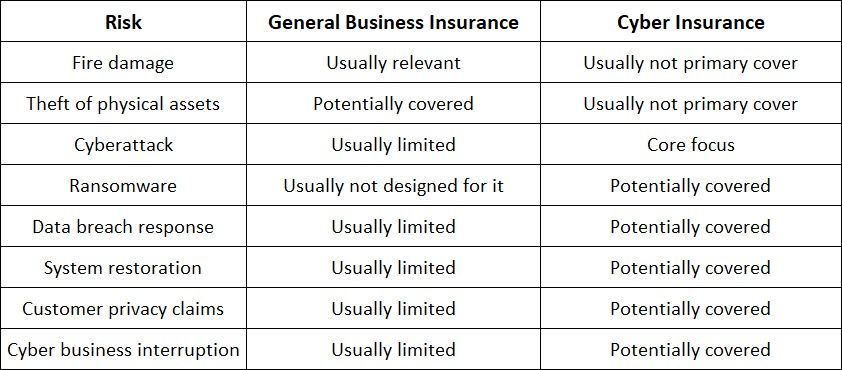
This is why businesses should not assume that a standard property or business package automatically provides adequate cyber protection.
How Much Does Cyber Insurance Cost for a Small Business?
There is no single standard premium.
The cost of a cyber insurance policy for business can depend on:
• Annual turnover
• Industry
• Number of employees
• Amount and type of data handled
• IT infrastructure
• Cloud usage
• Cybersecurity controls
• Claims history
• Policy limit
• Business interruption exposure
• Geographical operations
• Requested coverage extensions
A business with strong cybersecurity controls may present a different risk profile from a business with weak access controls, no tested backups or outdated systems.
Cyber Insurance Checklist for Small Businesses
Before buying a policy, review:
• Ransomware coverage
• Cyber extortion coverage
• Data restoration
• System restoration
• Business interruption
• Incident response
• Forensic investigation
• Customer notification expenses
• Legal expenses
• Privacy liability
• Network security liability
• Regulatory investigation coverage
• Social engineering/funds transfer fraud extensions
• Waiting periods
• Deductibles
• Coverage limits
• Territorial limits
• Key exclusions
Cyber Insurance and IRDAI's Cybersecurity Framework
Cyber risk is increasingly important across the insurance ecosystem.
IRDAI has issued information and cybersecurity guidelines, including guidelines applicable to insurance intermediaries.
For businesses purchasing cyber insurance, this reinforces an important principle:
Insurance should complement—not replace—strong cybersecurity controls.
Final Takeaway: Is Cyber Insurance Worth It for a Small Business?
For a business that depends on computers, cloud applications, customer databases, online payments or digital operations, cyber risk can quickly become a financial risk.
A well-designed cyber insurance policy for business can potentially help manage expenses associated with:
Cyberattack → Investigation → Legal response → Notification → Restoration → Business interruption → Recovery
The most important step is to compare the actual coverage rather than selecting a policy based only on price.
Look carefully at ransomware insurance coverage, cyber extortion, system restoration, data restoration, notification expenses, business interruption, liability protection, deductibles and exclusions.
For an SME, the right cyber policy can become an important component of its broader business continuity and risk-management strategy.
Insurance coverage is subject to the terms, conditions, exclusions, definitions and limits of the specific policy. This article is for general educational purposes and should not be treated as legal or regulatory advice.
FAQs
1. What is covered under commercial cyber insurance in India?
Commercial cyber insurance may cover eligible first-party and third-party losses arising from covered cyber incidents. Depending on the policy, this can include incident response, forensic investigation, data and system restoration, business interruption, cyber extortion, notification expenses and certain liability claims.
2. Does cyber insurance cover ransomware attacks?
Potentially. Many cyber policies can provide ransomware-related protection, but coverage varies. Check the cyber extortion, data restoration, business interruption and applicable exclusions sections.
3. Does cyber insurance cover ransom payments?
Not automatically. Any ransom or extortion payment must be specifically covered and legally permissible. Businesses should review the policy wording and applicable law before assuming such payments are insured.
4. Does cyber insurance cover data breach notification costs?
Some policies provide coverage for eligible notification and response expenses following a covered data breach.
5. Does cyber insurance cover system restoration?
It can. Policies may cover eligible expenses needed to restore affected systems following a covered cyber event.
6. Does cyber insurance cover business interruption?
Many policies can provide business interruption protection for covered cyber incidents, subject to waiting periods, limits and policy conditions.
7. Is cyber insurance mandatory for small businesses in India?
There is no universal rule making cyber insurance mandatory for every small business. However, businesses may have regulatory, contractual or customer requirements depending on their industry and operations.
8. Does cyber insurance replace cybersecurity?
No. Insurance is a financial risk-transfer mechanism. Cybersecurity is a prevention and risk-reduction mechanism. A business should ideally use both.
9. How Much Does Cyber Insurance Cost in India?
The cost of Cyber Insurance in India depends on factors such as business size, industry, turnover, data handled, cybersecurity controls, claims history, coverage limit and selected policy benefits.
10. What Does Cyber Insurance Actually Cover?
Cyber Insurance can cover eligible financial losses from covered cyber incidents, including incident response, data restoration, system restoration, business interruption, cyber extortion, legal expenses and certain third party claims. Coverage depends on the policy terms and exclusions.