Health Insurance
Your Insurance Questions Answered Top Queries in 2026
This blog answers the most common insurance questions people are asking in 2026 as risks and coverage needs continue to evolve. It explains how much insurance is enough, whether corporate cover is sufficient, and what policies suit professionals and freelancers. The article clarifies term insurance, riders, and claim-related concerns with practical insight. It helps readers make informed insurance decisions with confidence and clarity.
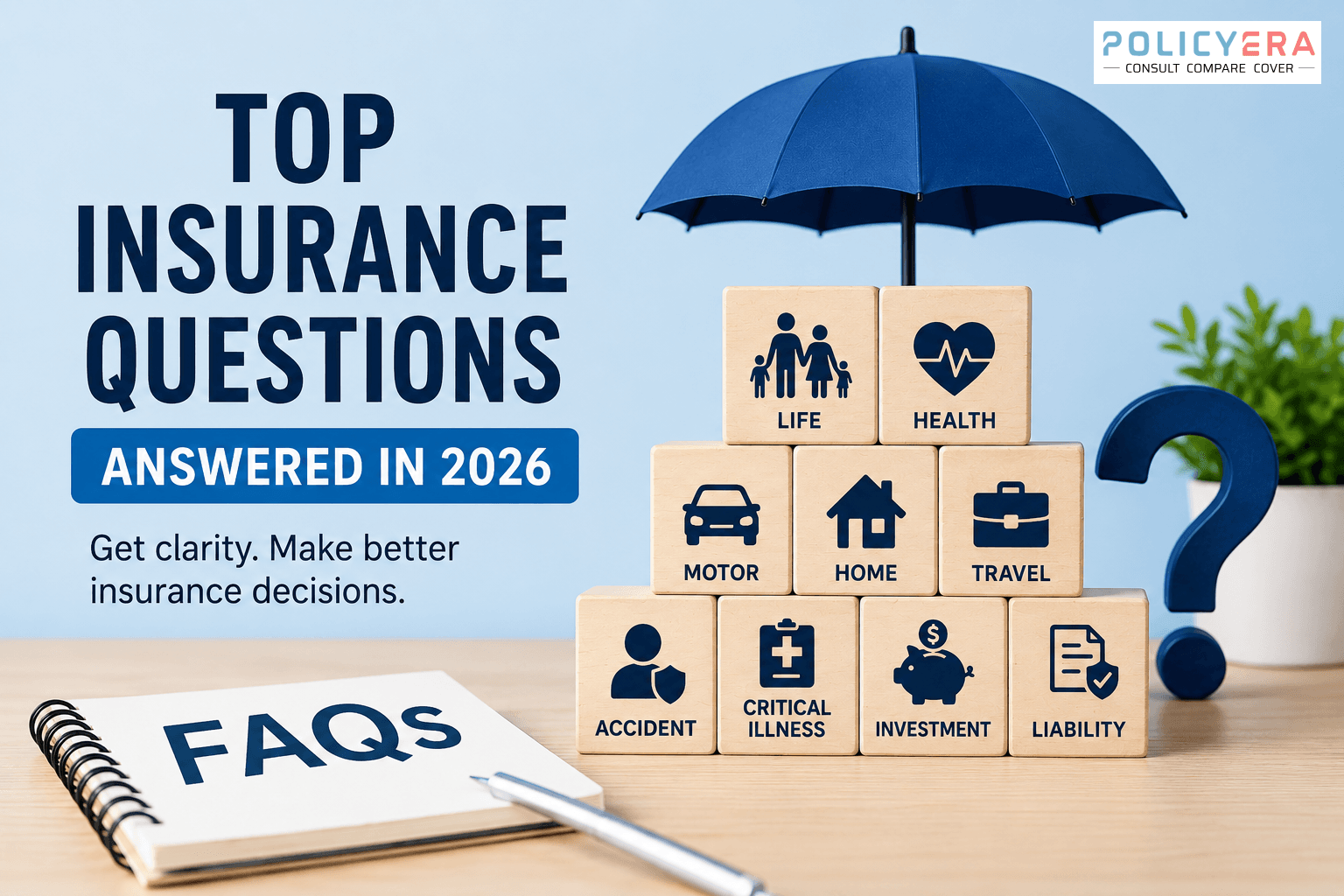
Insurance FAQs and key insurance categories represented under a protective umbrella.
As insurance awareness grows across India, so do the questions around adequacy, relevance, and reliability of coverage. In 2026, individuals are more informed, but also more confused, due to the wide range of products, riders, and marketing narratives in the insurance space. Rising healthcare costs, changing work patterns, and evolving family responsibilities have made insurance planning more complex than ever.
This blog addresses the most frequently asked insurance questions in 2026, offering clarity for salaried individuals, professionals, freelancers, and families seeking meaningful financial protection.
How Much Insurance Cover Is Actually Enough in 2026
Determining how much insurance cover is enough is no longer a simple calculation. Inflation, lifestyle changes, and increasing life expectancy mean that older benchmarks are often insufficient.
For life insurance, coverage should reflect income replacement rather than premium affordability. A commonly accepted approach is to secure cover that is at least ten to fifteen times annual income, adjusted for existing liabilities such as home loans, education expenses, and dependent family members.
Health insurance adequacy depends on location, hospital preferences, and family size. With medical inflation rising steadily, urban families often require significantly higher coverage than before to manage hospitalisation, treatment, and post care expenses.
Key considerations include
• Current income and future earning potential
• Outstanding loans and long term financial goals
• Number of dependents and their needs
• City-specific healthcare costs
Adequate insurance in 2026 is about future-proofing, not minimum compliance.
Is Corporate Health Insurance Enough, or Do I Need My Own Policy
Employer-provided health insurance offers valuable protection, but relying solely on it can be risky. Corporate policies are designed for group coverage and often come with coverage caps, exclusions, and limited flexibility.
One of the biggest concerns is continuity. Corporate health insurance ends the moment employment changes, leaving individuals exposed during transitions or retirement. Additionally, group policies may not cover all family members comprehensively or allow sufficient sum insured upgrades.
An individual health insurance policy provides personal control, lifelong renewability, and the ability to customise coverage based on personal medical history and lifestyle.
Why individual coverage matters
• Protection continues regardless of job changes
• Higher and flexible sum insured options
• Better coverage for long-term treatments
• Ability to build waiting periods early
In 2026, corporate health insurance should be seen as supplementary, not a replacement.
What Insurance Should Self-Employed Professionals and Freelancers Buy
With the rise of freelance work, consulting, and independent practice, a large section of the workforce operates without employer-backed insurance benefits. This makes personal insurance planning essential.
Health insurance is the foundation, ensuring access to quality care without financial strain. Life insurance becomes critical for those with dependents or financial responsibilities, even without a fixed monthly salary.
Profession-specific risks also need attention. Doctors, consultants, architects, and service providers face legal and professional exposure that requires specialised coverage.
Essential insurance for self-employed individuals includes
• Comprehensive health insurance with adequate sum insured
• Term life insurance aligned to income and liabilities
• Professional indemnity where applicable
• Personal accident cover for income protection
For freelancers, insurance is not optional security. It is business continuity.
Is Term Insurance Still Better Than Investment-Linked Plans
Despite the popularity of investment-linked insurance products, term insurance remains the most efficient form of life protection in 2026. Its core strength lies in offering high coverage at an affordable premium, without mixing insurance with investment risk.
Investment-linked plans often promise returns alongside insurance, but the cost of insurance within these products is significantly higher, reducing transparency and flexibility. Returns are also subject to market performance and charges.
Term insurance allows individuals to separate protection and investment decisions, choosing insurance purely for risk cover and investing elsewhere based on risk appetite.
Why term insurance continues to lead
• Higher life cover at lower cost
• Transparent structure and clear purpose
• Flexibility to choose independent investments
• Better suitability for income replacement
For families seeking financial security, term insurance remains the cornerstone.
What Riders Are Actually Useful and Which Ones Can I Skip
Riders enhance base policies, but not all riders add meaningful value. In 2026, choosing riders requires clarity on personal risk exposure rather than opting for every add-on offered.
Some riders provide essential protection, while others overlap with existing coverage or offer limited benefit relative to cost.
Generally useful riders include
• Critical illness rider for serious health conditions
• Accidental death and disability rider for income protection
• Waiver of premium rider during disability or illness
Riders that may be unnecessary include
• Minor benefit riders with restrictive conditions
• Riders duplicating existing health or accident policies
• Low payout riders with high premiums
Selective rider choice ensures better value without overpaying.
How Do I Avoid Claim Rejection
Claim rejection remains one of the biggest concerns for policyholders. In most cases, rejections occur due to disclosure gaps, documentation issues, or misunderstanding policy terms rather than deliberate denial.
Honest and complete disclosure at the time of purchase is the most critical step. This includes declaring medical history, lifestyle habits, and occupational risks accurately.
Understanding policy conditions, waiting periods, and exclusions is equally important. During claims, timely intimation and proper documentation play a decisive role.
Best practices to avoid claim rejection
• Disclose all relevant information truthfully
• Read policy wordings and exclusions carefully
• Maintain medical and financial records
• Inform insurers promptly during claim events
• Seek guidance from authorised advisors
A well understood policy is far less likely to fail when needed most.
Conclusion
Insurance planning in 2026 demands informed decisions rather than assumptions. As life becomes more dynamic and risks more interconnected, asking the right questions is the first step toward meaningful protection. From determining adequate coverage to understanding the role of riders and avoiding claim issues, clarity empowers policyholders to make confident choices. The right insurance strategy does not simply protect against loss. It enables stability, continuity, and peace of mind in an increasingly uncertain world.
FAQs
1. How Much Does Health Insurance Really Cost?
Health insurance costs vary based on age, coverage amount, location, medical history, and policy features. A higher sum insured and wider coverage generally result in a higher premium. Comparing plans based on coverage, exclusions, waiting periods, and benefits can help you choose affordable health insurance.
2. What Type of Insurance Do I Actually Need?
The insurance you need depends on your age, income, family responsibilities, profession, and financial risks. Health insurance and term insurance are important for many individuals, while personal accident, professional indemnity, motor, or other policies may be relevant based on your specific needs.
3. How to Lower Your Insurance Premiums?
You can lower insurance premiums by comparing different plans, choosing an appropriate coverage amount, maintaining a healthy lifestyle, and avoiding unnecessary add-ons. However, choosing a policy only because it has a lower premium may result in inadequate coverage.
4. Is Insurance a Good Career Choice?
Yes, insurance can be a good career choice for people interested in finance, sales, customer service, and risk management. The industry offers opportunities across insurance companies, brokers, agencies, underwriting, claims, and advisory roles.
5. How Much Do Insurance Agents Actually Earn?
Insurance agent earnings vary based on experience, products sold, commissions, customer base, and business performance. Income can increase as agents build a strong client network and generate consistent business, but earnings are not fixed and may vary significantly.
6. Can You Get Into Insurance Without Experience?
Yes, many entry-level insurance roles do not require prior industry experience. Candidates can start in areas such as sales, customer support, operations, or claims and develop their knowledge through training, certifications, and practical experience.