Health Insurance
Health Insurance Claim Settlement Ratio (CSR): Top Insurers Compared
Health insurance infographic comparing CSR, ICR, claim speed, and network hospitals.
Choosing health insurance is not simply about finding the lowest premium. The real test of an insurance policy comes when you or your family needs to make a claim. This is why many buyers search for the best health insurance company based on its claim settlement track record.
One of the most commonly discussed metrics is the health insurance claim settlement ratio (CSR). It can provide useful information about how an insurer has handled claims historically, but CSR should not be viewed in isolation.
A better comparison combines claim settlement ratio with Incurred Claim Ratio (ICR), claim settlement speed, network hospitals, complaints, solvency, policy exclusions, waiting periods and coverage features.
So, which health insurance has the best claim settlement ratio? The answer depends on the metric and financial year being considered. Based on FY 2022–23 to FY 2024–25 data compiled from insurer disclosures and IRDAI annual-report data, insurers such as New India Assurance, Digit, Bajaj General, HDFC ERGO, Acko and Aditya Birla have reported strong CSR performance. However, a high CSR does not automatically mean that every claim will be paid in full or settled instantly.
Which Health Insurance Has the Best Claim Settlement Ratio?
If you compare the three-year average CSR from FY 2022–23 through FY 2024–25, New India Assurance and Digit are among the strongest performers in the available comparison, followed by Bajaj General, HDFC ERGO, Acko, SBI General and Aditya Birla Health Insurance.
The three-year comparison is more useful than looking at one year's number because a single year's result can be affected by changes in business mix, claim volumes and other factors.
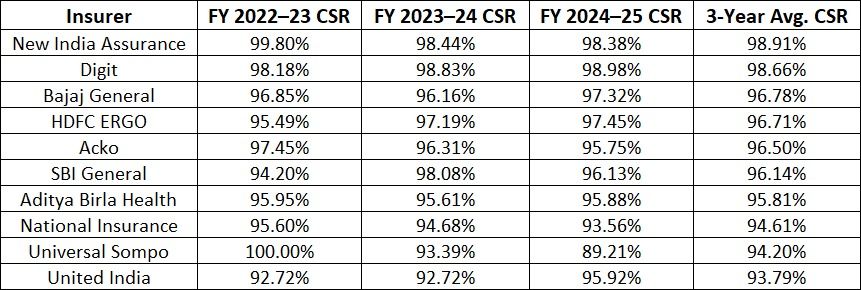
Source: insurer public disclosures and IRDAI annual-report data as compiled in current insurance data resources.
Important: This table should not be interpreted as a definitive "best insurer" ranking. Some insurers are standalone health insurers, while others are general insurers with health portfolios. The basis and methodology used to calculate CSR can also differ between datasets.
What Is Health Insurance Claim Settlement Ratio?
The health insurance claim settlement ratio indicates the proportion of claims settled by an insurer compared with claims received during a particular period, according to the methodology used for that dataset.
A simplified formula is:
Claim Settlement Ratio = (Number of Claims Settled ÷ Number of Claims Received) × 100
For example, if an insurer receives 10,000 claims and settles 9,500 claims, its claim settlement ratio would be 95%.
A high CSR generally indicates that the insurer has settled a large proportion of claims. But it does not tell you everything about:
• The amount paid for each claim
• Whether claims were fully or partially settled
• How quickly claims were settled
• Why some claims were rejected
• Whether specific treatments are excluded
• Whether your preferred hospital is in the network
Therefore, CSR is a screening metric, not a complete measure of policy quality. How Is Claim Settlement Ratio Calculated?
The basic calculation can be expressed as:
CSR = Claims Settled ÷ Claims Received × 100
Suppose an insurer receives 50,000 claims during a financial year and settles 48,000.
CSR = 48,000 ÷ 50,000 × 100
CSR = 96%
This means 96 out of every 100 claims were settled according to that calculation.
However, policyholders should avoid interpreting this as a guarantee that their own claim will be approved.
What Does a 95% Claim Settlement Ratio Mean?
A 95% CSR generally means that 95 out of every 100 claims were settled under the particular methodology and reporting period.
It does not mean:
• 95% of the claim amount was paid.
• Every claim was paid in full.
• The claim was settled immediately.
• Future claims will also have a 95% settlement rate.
This distinction is extremely important when comparing the best health insurance company.
Latest Health Insurance Claim Settlement Ratio: Top Insurers Compared
The latest available IRDAI Handbook for FY 2024–25 was released in February 2026. For SEO and reader clarity, it is useful to compare CSR with other metrics rather than presenting CSR alone.
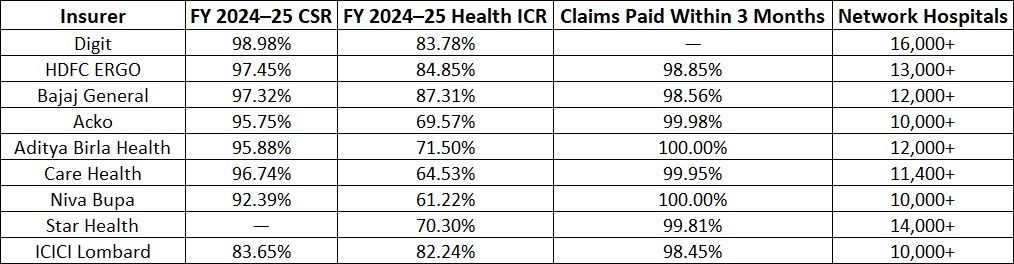
CSR figures can vary by reporting methodology/source; the table uses the insurer/public-disclosure CSR series used in the referenced data sources.
Network-hospital counts are approximate and can change over time.
CSR and ICR figures are based on FY 2024–25 insurer/IRDAI data compiled by current insurance data sources.
The "claims paid within three months" figures are a separate IRDAI reporting metric. For example, IRDAI's FY 2024–25 data shows 100% for Aditya Birla, Galaxy and Narayana among the standalone health insurers listed, 99.95% for Care, 99.88% for ManipalCigna and 99.81% for Star. Acko led private general insurers at 99.98%, followed by Reliance General at 99.32%.
Why This Table Is Better Than a Simple CSR Ranking
A simple "Top 10 health insurers by CSR" list may attract clicks, but it does not fully answer the consumer's question: Which is the best health insurance company?
For example:
• One insurer may have a very high CSR but a lower ICR.
• Another may have a strong CSR and a broad hospital network.
• Another may have excellent claim-speed data.
• Another may have a lower CSR but stronger coverage features for a particular customer profile. This is why consumers should compare multiple metrics before buying.
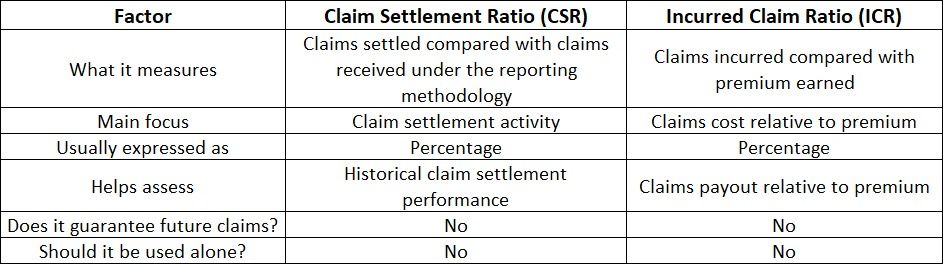
CSR vs ICR: What Is the Difference?
CSR and ICR are often confused, but they measure different things.
What Is Incurred Claim Ratio in Health Insurance?
The Incurred Claim Ratio broadly measures the amount an insurer incurs in claims compared with the premium it earns.
A simplified formula is:
ICR = Net Claims Incurred ÷ Net Earned Premium × 100
For example, an ICR of 80% broadly means that ₹80 of claims were incurred for every ₹100 of earned premium, subject to the accounting definitions used in the reporting. FY 2024–25 health-segment ICR figures reported from IRDAI data include HDFC ERGO at 84.85%, ICICI Lombard at 82.24%, Bajaj General at 87.31%, Aditya Birla Health at 71.50%, Care Health at 64.53%, Niva Bupa at 61.22% and Star Health at 70.30%.
Why You Should Not Choose a Health Insurer Based Only on CSR
A high CSR is positive, but it cannot answer every important question.
Consider two hypothetical insurers:
Insurer A
• CSR: 98%
• Weak hospital availability in your city
• Several policy exclusions
• High co-payment
• Strict room-rent limits
Insurer B
• CSR: 96%
• Strong hospital network near your home
• Better coverage
• No room-rent restriction
• Lower co-payment
• Better restoration benefits
For a particular customer, Insurer B could potentially be the more suitable option despite having a slightly lower CSR.
The "best health insurance company" therefore depends on policy features + claims experience + financial strength + service + customer requirements.
Claims Paid Within 3 Months vs Claim Settlement Ratio
This is one of the most important content gaps you can target.
IRDAI's FY 2024–25 data reports the percentage of claims paid in less than three months separately. For standalone health insurers, the industry figure was 99.93%.
That metric should not simply be labelled as CSR.
For example:
• "99.95% claims paid within three months" describes claim timing.
• "96.74% CSR" describes a claim settlement ratio calculation.
• "64.53% ICR" describes claims incurred relative to earned premium.
Using the correct terminology makes your article more trustworthy and gives it an advantage over pages that combine these numbers.
Best Health Insurance Company: What Other Factors Matter?
Network Hospitals
A large network hospital count can be useful, but the total number is not enough. Check whether the insurer has cashless hospitals:
• Near your home
• Near your workplace
• In your hometown
• In cities you frequently visit
• At hospitals you already prefer
A company advertising thousands of network hospitals is less useful if your preferred hospital is not part of the network.
Claim Settlement Speed
Speed matters during hospitalization.
IRDAI's FY 2024–25 data indicates very high percentages of claims paid within three months among several standalone health insurers.
However, consumers should also understand the difference between:
• Cashless pre-authorisation
• Final discharge approval
• Reimbursement claims
• Query resolution
• Claim repudiation
• Partial settlement
Waiting Periods and Exclusions
A high CSR cannot compensate for a policy that does not cover your medical requirement. Check:
• Initial waiting period
• Pre-existing disease waiting period
• Specific disease waiting period
• Maternity waiting period
• Permanent exclusions
• Modern treatment coverage
• Non-medical expenses
Room Rent and ICU Limits
A policy may advertise a large sum insured but still contain room-rent restrictions.
Before purchasing, check whether the policy provides:
• No room-rent limit
• No ICU sub-limit
• Proportionate deduction provisions
• Specific room-category restrictions
Co-Payment and Deductibles
A policy with a lower premium may require you to pay a portion of eligible expenses.
For example, with a 20% co-payment, a policyholder may have to bear 20% of an eligible claim amount, subject to the policy terms.
Therefore, compare premium and out-of-pocket exposure together.
Restoration and No-Claim Benefits
Many modern health policies offer benefits such as:
• Sum insured restoration
• No-claim bonus
• Cumulative bonus
• Recharge benefits
• Automatic reinstatement
But the exact conditions matter.
A restoration benefit may have restrictions on whether it can be used for the same illness, multiple claims or specific members of a family floater.
How to Choose the Best Health Insurance Company in India
Instead of asking only "Which company has the highest CSR?", use this checklist.
Step 1: Check 3-Year CSR
Look for consistency rather than focusing on one year's number.
Step 2: Check Health-Segment ICR
For general insurers, make sure you are looking at the health segment, not an overall ratio covering unrelated insurance products.
Step 3: Check Claims Paid Within Three Months
This provides a separate view of settlement speed and should not be confused with CSR.
Step 4: Check Your Local Hospital Network
Search for hospitals that you are actually likely to use.
Step 5: Read the Policy Wordings
Focus particularly on:
• Waiting periods
• Exclusions
• Co-payment
• Room-rent restrictions
• Sub-limits
• Disease-specific limits
• Non-medical expenses
Step 6: Check Financial Strength
Consider the insurer's solvency and overall business position along with claims data.
Step 7: Compare the Actual Policy
Two insurers can have similar CSR figures but very different policy terms.
Is a 100% Claim Settlement Ratio Always Better?
Not necessarily.
A 100% ratio for a particular year sounds excellent, but it needs context.
Ask:
• How many claims were involved?
• What was the previous year's performance?
• What is the three-year trend?
• What is the insurer's ICR?
• What is the claim volume?
• What are customer complaints?
• How quickly are claims paid?
• What does the actual policy cover?
A ratio should be interpreted together with the size, consistency and context of the underlying business.
What Is the Best Way to Compare Health Insurance Companies?
A useful scoring framework is:
30% — Policy Coverage
20% — Claim Performance
15% — Claim Settlement Speed
15% — Hospital Network
10% — Customer Complaints & Service
10% — Financial Strength
This approach prevents a single statistic from dominating the purchase decision.
Final Verdict: Which Is the Best Health Insurance Company?
There is no single insurer that can objectively be declared the best health insurance company for every customer based only on CSR.
If your priority is historical CSR consistency, the available FY 2022–23 to FY 2024–25 data puts insurers such as New India Assurance, Digit, Bajaj General, HDFC ERGO, Acko, SBI General and Aditya Birla Health among the stronger performers in the cited comparison.
At the same time, the FY 2024–25 IRDAI data on claims paid within three months shows exceptionally high settlement-speed percentages for several standalone health insurers and private general insurers.
Therefore, the smarter question is not simply:
Which health insurance company has the highest claim settlement ratio?
It is:
Which health insurance company offers the right combination of claim performance, settlement speed, hospital network, coverage, exclusions, service and financial strength for my needs?
That is the approach consumers should use when selecting health insurance.
Key Takeaway
The best health insurance company is not necessarily the company with the highest claim settlement ratio.
CSR tells only one part of the story.
For a better decision, compare CSR + ICR + claims paid within three months + network hospitals + complaints + policy wording + coverage + financial strength.
That combination gives consumers a much more realistic picture of what they can expect from a health insurance company when they actually need to make a claim.
FAQs
1. What is a good claim settlement ratio for health insurance?
A consistently high CSR can be a positive indicator, but there is no single CSR number that guarantees a good insurance experience. Compare at least three years of data along with ICR, complaints, claim speed and policy terms.
2. Is 95% claim settlement ratio good?
A 95% CSR is generally a strong historical figure, but consumers should not interpret it as a guarantee that 95% of the claim amount will be paid.
3. Is claim settlement ratio more important than premium?
No. A low premium does not necessarily mean better value, and a high CSR does not necessarily mean better coverage. Compare the policy's actual benefits, exclusions and cost together.
4. Should I check CSR before buying health insurance?
Yes, CSR can be one useful comparison metric. But it should be combined with ICR, claims speed, network hospitals, complaints, policy exclusions and financial strength.
5. Does a high CSR mean all claims are paid?
No. CSR is an aggregate historical metric. Individual claims can still be rejected, partially settled or excluded based on policy terms and claim circumstances.
6. Is a 99% Claim Settlement Ratio Really a Guarantee Your Claim Gets Paid?
No, a 99% claim settlement ratio does not guarantee that your individual health insurance claim will be paid. CSR is a historical aggregate measure and does not show whether claims are paid fully, partially or rejected. Always check policy terms, exclusions, waiting periods and other claim-related factors.
7. Why Do Insurance Companies Reject Claims Even With High Settlement Ratios?
Insurance companies can reject individual claims even when their claim settlement ratio is high because CSR does not guarantee approval of every claim. Rejections may depend on policy exclusions, waiting periods, non-disclosure, eligibility conditions or specific claim circumstances. The policy wording should be checked before making a claim.
8. Health Insurance CSR Explained: What Numbers Actually Matter to You
Health insurance CSR shows the proportion of claims settled under the relevant reporting methodology, but it should not be considered alone. Compare CSR with ICR, claims paid within three months, network hospitals, exclusions, waiting periods, co-payment and policy coverage to get a more complete view.
9. How to Check if Your Health Insurance Company Pays Claims on Time
To assess claim settlement speed, check the insurer's claims paid within three months data rather than relying only on CSR. This is a separate reporting metric that indicates how quickly claims have been paid. You should also review the insurer's claim process and policy terms.
10. What's a Good Claim Settlement Ratio and Why Should You Care?
A consistently high claim settlement ratio can be a useful indicator of historical claim settlement performance, but there is no single CSR that guarantees a good insurance experience. Compare at least three years of CSR along with ICR, claim speed, network hospitals, policy coverage and exclusions.