Health Insurance
What Type of Insurance Coverage Do Indians Prefer Now?
This blog examines current insurance preferences among Indian consumers and how protection priorities are evolving. It highlights growing demand for life, health, and comprehensive coverage driven by rising financial and medical risks. The piece explains key trends shaping consumer behaviour and coverage choices. It also underscores the importance of informed advisory support in translating preference into effective protection.
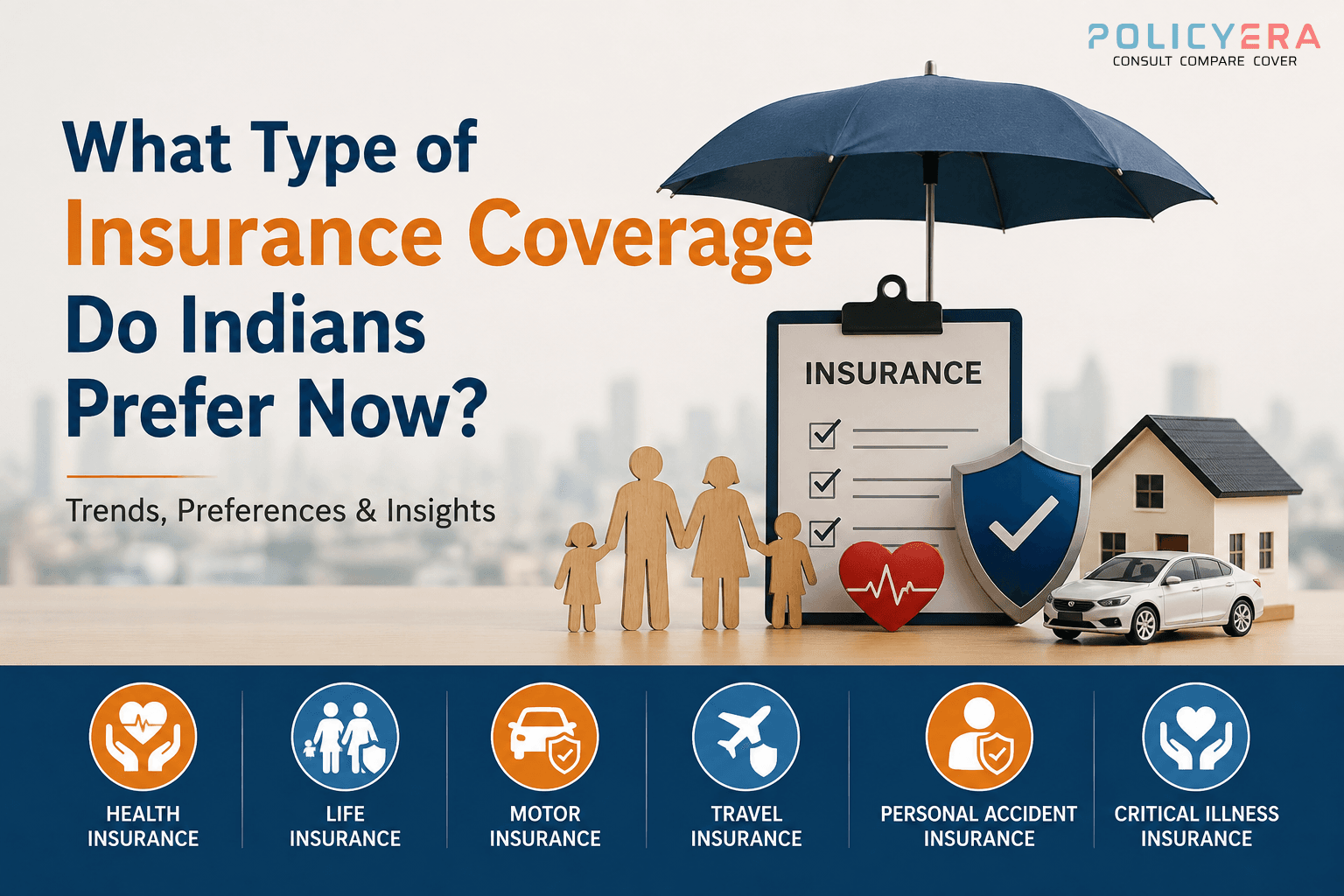
An infographic showing the insurance coverage Indians prefer, including health, life, motor, travel, personal accident, and critical illness insurance.
Understanding what kinds of insurance Indians are choosing today offers meaningful insights into how financial priorities are evolving in the country. With rising awareness around protection, healthcare costs, and long-term stability, consumer preferences are shifting towards coverage that provides not just basic risk management but broader financial security. Recent industry data and surveys highlight clear patterns in the types of insurance that Indian consumers are increasingly valuing in 2025–26, driven by changing demographics, lifestyle trends, and economic realities.
RISING DEMAND FOR COMPREHENSIVE LIFE AND RIDER-ENHANCED TERM INSURANCE
Term life insurance remains a core preference among Indian buyers, particularly in the 25–40 age bracket. Demand for term plans grew by an estimated 37 per cent in 2025, with many buyers opting for higher sum assured levels, often extending into the ₹1 crore range or above. This reflects a strong focus on income replacement and long-term financial security for dependants.
Alongside base term policies, riders such as Accidental Total Permanent Disability (ATPD), Accidental Death Benefit (ADB), and Critical Illness (CI) riders are gaining traction. Data from market research shows that rider attachment rates are increasing, particularly in southern and urban clusters, where awareness of broader risk coverage is stronger. Critical illness riders, which include protection for conditions like cancer, have become popular especially among women and younger buyers in metros, underscoring a shift from basic death benefit toward more comprehensive protection.
HEALTH INSURANCE IS A TOP PRIORITY
Health insurance has emerged as one of the most preferred types of coverage for Indians, frequently ranking above more traditional investments such as equities, mutual funds, and government bonds in consumer preference surveys. According to one report, over 28 percent of respondents placed health insurance above these investment options, highlighting how medical risk is rising as a financial priority.
Despite this preference, awareness gaps remain: many Indians choose relatively low sum insured levels — nearly 48 percent reporting a cover of ₹5 lakh or less — which may not be adequate given rising hospitalisation costs. Policyholders often underestimate the true cost of care, indicating that preference for health insurance is growing even as deeper education on coverage adequacy is needed.
MOTOR AND NON-LIFE INSURANCE TRENDS
Motor insurance continues to be a standard requirement, driven by increasing vehicle ownership and regulatory compliance. Innovations such as usage-based insurance (pay-as-you-drive or pay-how-you-drive) are emerging, offering cost savings and personalised premiums based on driving behaviour, which appeal to urban and cost-conscious consumers.
Other non-life segments such as personal accident insurance, fire, engineering, and liability products are also seeing growth, fuelled by both regulatory expectations and broader risk awareness. Personal accident premiums, in particular, have shown strong growth, reflecting rising concern about unplanned disability and income disruption.
PERSISTENT GAPS IN AWARENESS AND UNDERSTANDING
While preference data suggests increased interest in protection-oriented insurance, surveys also show that a large proportion of Indians may not fully understand what their policies cover. Around 80 percent of policyholders said they were unsure about key policy benefits, exclusions, or claim processes — despite owning multiple policies. This disconnect highlights the need for advisory-led insurance guidance that not only promotes purchase but ensures comprehension and effective utilisation of coverage.
What These Preferences Mean for Policyholders
The current insurance preferences among Indians reflect a transition from traditional minimum coverage to broader, protection focused solutions. Consumers are increasingly valuing:
• Comprehensive life cover with riders that extend protection beyond death benefits
• Health insurance as a priority financial product ahead of traditional investments
• Emerging non-life products that address modern lifestyle and mobility risks
• Customised and behaviour based covers that align premiums with actual risk exposure
At the same time, education and advisory support remain crucial to converting interest into effective financial protection.
HOW POLICY ERA HELPS ALIGN COVERAGE WITH PREFERENCES
Platforms like Policy Era are well positioned to help consumers navigate these evolving preferences. By offering expert advisory, transparent comparisons, and tailored recommendations across life, health, and non-life insurance categories, PolicyEra helps individuals and families choose comprehensive protection that reflects their actual needs.
Policy Era’s approach emphasises clarity, suitability, and claims preparedness, ensuring that coverage aligns with long-term goals rather than minimum requirements. This balance between consumer preference and appropriate protection empowers policyholders to make confident decisions backed by informed insight.
CONCLUSION
Indian insurance buyers in 2025–26 clearly show a growing preference for wider, protection-oriented coverage across life, health, and non-life categories. As awareness of financial risk rises, demand for riders and innovative products is increasing alongside traditional policies. However, gaps in understanding coverage underline the importance of advisory-led solutions that help consumers not only choose insurance but live confidently with it.
Platforms like Policy Era play a pivotal role in this journey, guiding individuals and families to align insurance preferences with real world needs and long-term financial resilience.
FAQs
1. Do I Really Need a Health Insurance Agent or Can I Buy Online?
You can buy health insurance online, but an experienced insurance advisor can help you compare plans, understand exclusions, choose the right sum insured, and receive support during claims. This is especially useful when selecting coverage that matches your healthcare needs.
2. How Much Does Health Insurance Cost for a Single Person in India?
The cost of health insurance for a single person depends on factors such as age, medical history, city, coverage amount, and policy benefits. Comparing multiple plans helps you find the right balance between premium and coverage.
3. What Happens to My Health Insurance When I Change Jobs?
When you change jobs, your employer-sponsored group health insurance usually ends once your employment concludes or after the policy's specified coverage period. To avoid a gap in protection, you should check whether your new employer offers group health insurance and when the coverage begins. If there is a waiting period or limited benefits, having an individual health insurance policy can ensure continuous financial protection and uninterrupted access to healthcare.
4. How Do Life Insurance Riders Work? Simple Explanation
Life insurance riders are optional add-ons that increase the scope of your policy for an additional premium. They provide extra financial protection for specific events such as critical illnesses, accidental death, or permanent disability, depending on the rider selected.
5. Does Your Job Require You to Use Your Personal Car? Here's What Insurance You Need
If you use your personal car for work-related travel, ensure your motor insurance provides adequate coverage. Depending on how the vehicle is used, you may also benefit from comprehensive motor insurance and additional personal accident protection.
6. Can Your Employer Check Your Car Insurance Policy?
Generally, employers cannot access your car insurance policy without your permission. However, if driving is part of your job responsibilities, they may ask you to provide proof of valid insurance to meet company or legal requirements.